★★★★★
257 Reviews
Leggi tutte


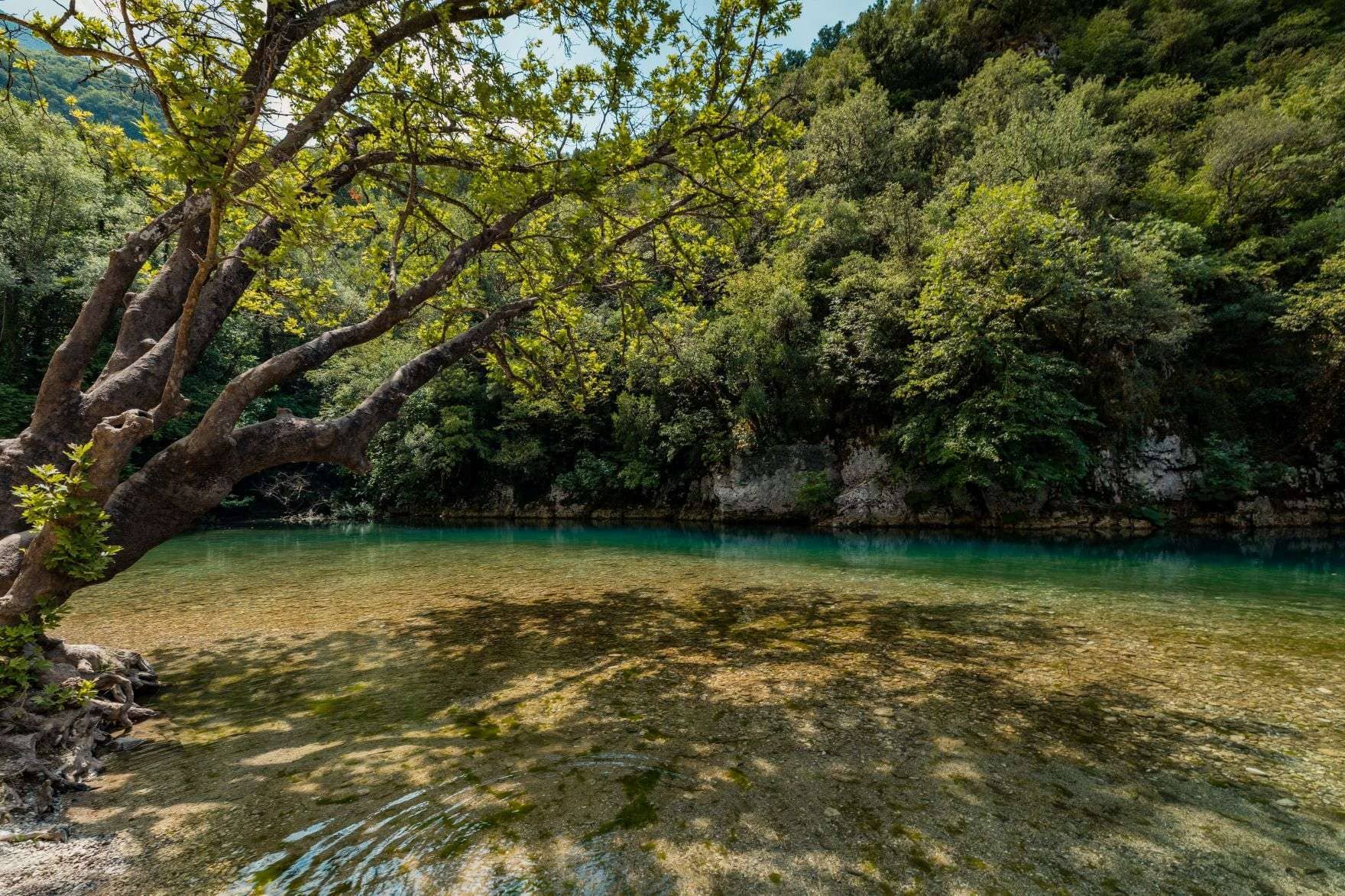
The Voidomatis River is one of the most astonishing natural wonders of Epirus, in north-western Greece. It is a tributary of the Aoos (Vjosa) River, one of the few rivers in Europe that still flows freely and remains unspoilt. Approximately 15 kilometres long, the Voidomatis flows through the Vikos-Aoos National Park, one of the most spectacular in the entire continent, famous for its gorges, wild nature, crystal-clear springs and stone villages of the Pindus.
Its course officially begins within the Vikos Gorge, an extremely deep canyon that for years was listed in the Guinness World Records as “the deepest gorge in the world in relation to its width”. From here, the river comes to life through dozens of underground springs that emerge from the limestone rock with an almost unreal clarity: the water is so transparent that even at depth you can see smooth pebbles, soft algae, cold-water fish and emerald reflections that change colour depending on the light.
The Voidomatis then flows through forests of birch trees, plane trees, beech trees and firs, passing traditional villages such as Papigo, Aristi and Vikos, immersed in landscapes that seem to have come straight out of a mountain fairy tale. Its flow remains constant throughout the year thanks to the numerous springs, and the water temperature is one of the river’s most iconic features: it rarely exceeds 4–6°C, even in the height of summer.
Geographically, the Voidomatis is a natural boundary between mountains, gorges and plateaus. The combination of incredibly pure water, white pebble riverbeds, lush vegetation and absolute silence makes it one of the most photographed places in Epirus. Here nature puts on a show in every season: in spring the river reflects the intense green of the new vegetation, in summer it appears like a refreshing oasis, in autumn it becomes a palette of reds and oranges, while in winter it creates an almost mystical atmosphere, surrounded by mist and ice.
Voidomatis is not simply a river: it is a natural sanctuary, a place that enchants anyone fortunate enough to approach its waters.
Reaching the Voidomatis is a journey along some of the most beautiful scenic roads in all of Greece. The main reference point for reaching the river is the city of Ioannina, overlooking the enchanting Lake Pamvotida and well connected to the rest of Greece via the Egnatia Odos motorway.
From Ioannina to Vikos-Aoos National Park
Once you leave the city, drive towards Konitsa or Zagori, depending on the exact point of the river you want to visit. The most beautiful areas for accessing the Voidomatis are:
The road is paved, well maintained and surrounded by mountain scenery that suddenly opens onto valleys of wild beauty. As you approach the park, the landscape changes: increasingly dense forests, seasonal waterfalls, imposing rock faces and small stone houses with the grey slab roofs typical of Zagori.
This is the easiest access point and the most popular with those who want to trek along the river. From the centre of the village, a road descends towards the famous Aristi Bridge, a masterpiece of traditional Epirote architecture. Here you will find one of the most scenic spots along the Voidomatis, ideal for photographs, walks and sporting activities.
Megalo Papigo and Mikro Papigo are among the most iconic villages of Zagori. From here you can reach the upper part of the canyon and follow trails that run alongside the river or descend towards the hidden springs in the gorge.
More distant but evocative, perfect for those who want to explore the point where the Voidomatis joins the great Aoos River.
Absolutely yes.
The park is vast and public buses are very rare. GPS navigation works well but cannot replace the experience of stopping along the road at the many panoramic viewpoints.
In summer it is also possible to reach the river through organised tours (rafting, kayaking, hiking), while in winter greater caution is required, especially in the section near the springs as the roads can be icy.
Reaching the Voidomatis means already beginning to connect with the landscape: every bend, every forest, every bridge tells you that you are entering the realm of Europe’s purest water.
The Voidomatis is a young river from a geological point of view, but the area it flows through is one of the richest historical treasure troves in northern Greece.
The entire area of Zagori and the Vikos Gorge has been inhabited since prehistoric times. The caves of the region have yielded stone tools, animal bones, remains of primitive pottery and traces of pastoral settlements that predate the arrival of the Hellenes by thousands of years. This territory was probably one of the fundamental routes for populations migrating between the Pindus and the Ionian coast.
During the Classical period, the Voidomatis flowed through the territories of the Epirotes, a fascinating and complex people, famous for their connection with nature and for the cults dedicated to Zeus, whose most ancient form was linked precisely to the nearby oracle of Dodona. Although the area was difficult to reach and sparsely urbanised, it was strategically important for passage between the Pindus Mountains and the highlands of Epirus.
During the Middle Ages, when Epirus was part of the Byzantine Despotate, the Voidomatis valley became a safe refuge from invaders and warriors. Many of the small stone villages of Zagori arose during this period, benefiting from forms of autonomy granted by the Byzantine rulers and, later, by the Ottomans.
In the 17th and 18th centuries the area became an important cultural centre: the schools of Zagori, local merchants and brotherhoods of stone builders made Epirus a wealthy and dynamic place. Many of the magnificent arched bridges that dot the Voidomatis were built during this period.
The 20th century was more complex: the Balkan Wars, occupation, partisan resistance and rural depopulation profoundly affected the area. And it is precisely thanks to its isolation that the Voidomatis has survived intact to this day, pure, completely free from pollution and major human intervention.
The history of the Voidomatis is the history of Greece at its most mountainous, ancient and wild: shaped by adaptation, resistance and harmony with nature.
Like all of Epirus, the Voidomatis is also surrounded by a powerful mythological aura. For the ancients, rivers were living beings: they had a character, a divine origin and a personality. The Voidomatis is no exception.
Literally, it means “ox eye” or “bull’s eye river”.
According to an ancient tradition, the name derives from an archaic ritual: during agricultural festivals, a bull was sacrificed to the river deities so that they would protect the waters and the flocks. The reflection of the animal’s eyes in the crystal-clear water is said to have given rise to the name.
Another interpretation links it to the Slavic word Voda, meaning “pure water” or “sacred water”. And this is where myth and reality meet: the Voidomatis is indeed considered one of the purest rivers in Europe.
Many local tales speak of nymphs that inhabited the waters of the river. They were said to be benevolent spirits, protectors of children and shepherds, capable of appearing at the most critical moments to show the way to travellers lost in the forest.
The elders of the Zagori villages told stories of “waters that speak”, especially on full-moon nights when the river produces a crystalline sound that echoes through the canyon.
A few kilometres from the Voidomatis stood the ancient oracle of Zeus Dodonaios: a sacred oak that spoke through the wind. Many priests and pilgrims arrived here passing close to the river.
Its waters were considered purifying and were used in rituals before consulting the oracle.
For centuries it was believed that the Voidomatis had healing properties. It was not unusual for the sick, the injured or people suffering from joint pain to immerse themselves in its icy waters seeking relief.
Tradition says that “if the river welcomes you, the mountain will protect you”.
The Voidomatis, therefore, is not just water: it is a place of collective memory, spirituality and ancestral magic.
The purest river in Europe hides a surprising number of interesting facts that make the experience even more fascinating.
It almost never exceeds 4–6°C, even in July and August.
A true natural miracle linked to the underground springs of the Vikos Gorge.
There are no drains, factories or villages directly along its course.
The water of the Voidomatis is drinkable in many sections.
The section between Aristi Bridge and Kleidonia is considered one of the most beautiful in Europe for gentle rafting: perfect for families, photographers and beginners.
The most famous is the Kleidonia Bridge, but the entire river is dotted with ancient bridges built without cement, using traditional Epirote techniques.
Papigo, Aristi, Monodendri, Megalo Papigo: a unique architectural heritage made up of stone houses, flower-filled balconies and landscapes that look like paintings.
The river is home to wild trout, freshwater crabs, herons, otters and lush vegetation that creates natural tunnels.
The light, reflected by the white pebbles on the riverbed, creates turquoise and emerald shades that make it one of the most popular subjects among European photographers.
A local legend tells that some monks from the nearby Panagia Spiliotissa Monastery walked along a secret trail beside the Voidomatis every day to gather medicinal herbs.
The Voidomatis is more than a river: it is a living, perfect, harmonious ecosystem.
One of the most famous panoramic spots.
Here the water takes on an intense blue colour that seems unreal.
A masterpiece of the 18th century, built without mortar.
It is one of the best places for rafting and for taking unforgettable photographs.
A mystical, silent place, where the water emerges from the rock as though it were being born at that very moment.
Built on a cliff overlooking the river.
The atmosphere here is spiritual, intense, profound.
The most famous is the Vikos – Monodendri route, which offers spectacular views over the gorge and the river.
Pools of clear water surrounded by white limestone rocks.
Perfect for those who want a refreshing swim (a very refreshing one!).
One of the most photographed: dense forests, ancient bridges, turquoise water and absolute tranquillity.
The Voidomatis is one of those places you never forget: it gets inside you, leaving a powerful, almost poetic memory.




Pianifica la tua vacanza nelle isole greche
Niente pacchetti standard. Contattaci per un itinerario su misura che cattura l'anima delle isole.
Massimo 2 preventivi gratuiti
Dalle acque cristalline di Mykonos ai tramonti mozzafiato di Oia, il nostro team di esperti locali è pronto a curare ogni dettaglio della tua fuga greca. Non siamo solo un'agenzia — siamo il tuo ponte verso l'Egeo.
Risposta immediata garantita