★★★★★
257 Reviews
Leggi tutte


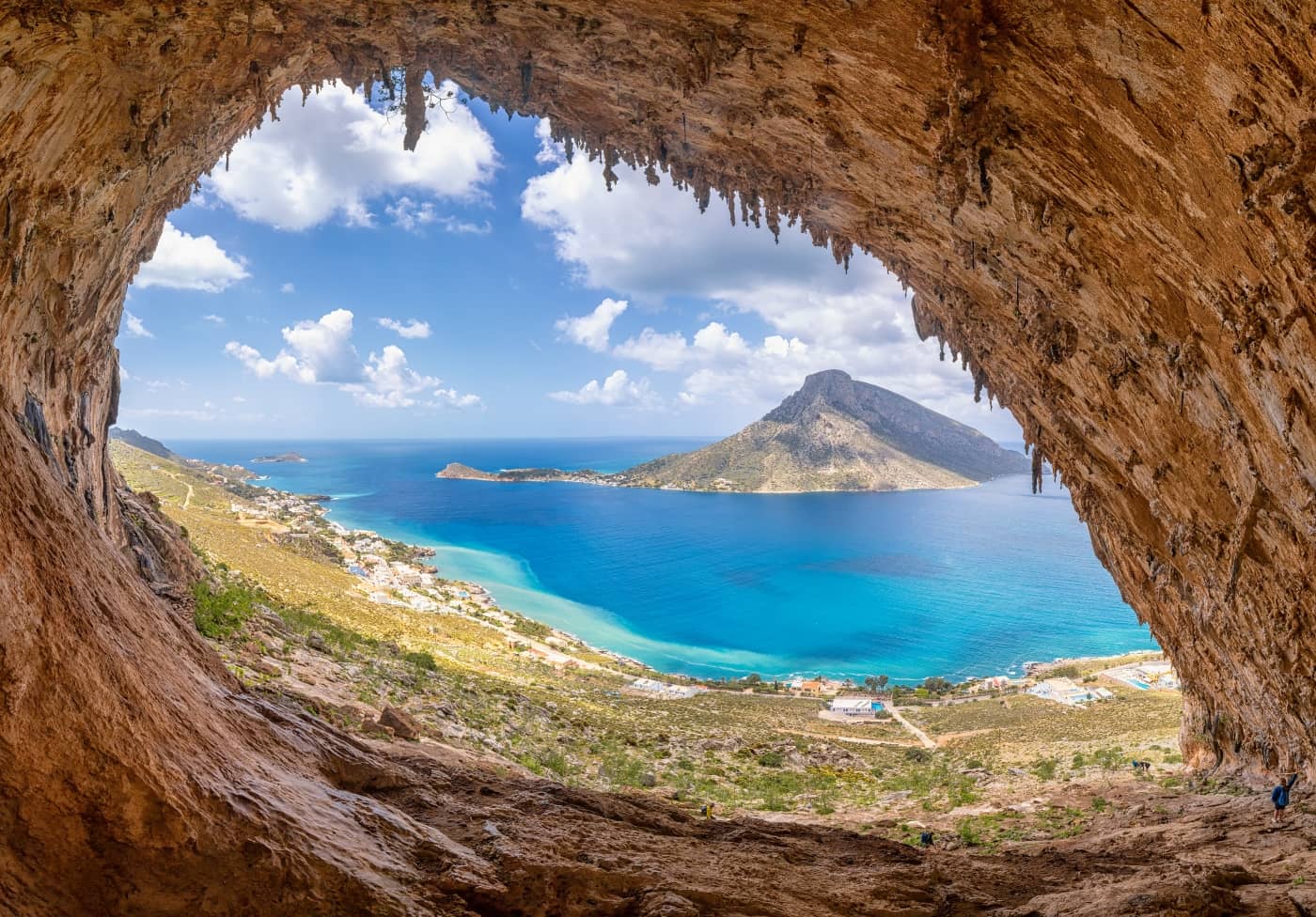
Choosing the Dodecanese for a climbing holiday means going beyond the simple concept of climbing and turning every ascent into a profound travel experience. Here, the rock is never separate from its surroundings: you climb overlooking the sea, feeling the Aegean wind, passing through authentic villages and islands that have preserved a slow and human pace.
The Dodecanese offers a unique vertical variety in Greece: from world-famous crags with thousands of perfectly bolted routes to wild islands where climbing is still about exploration, silence and instinct.
The mild climate makes it possible to climb almost all year round, and every day ends among crystal-clear bays and seaside villages. In the Dodecanese, climbing is not just a sport, but a complete travel experience, intense and deeply Mediterranean.
Here are the islands to discover and conquer through this wonderful sport.
There is a moment in Kalymnos when you realise that climbing here is not “an activity”: it is a language. You speak it while looking at the orange limestone plunging into the blue of the Aegean, you feel it beneath your fingers as you grip a perfect stalactite, you breathe it in during the evening, sitting at the tables of Massouri while the sun disappears behind Telendos.
Kalymnos is in the Dodecanese, very close to Kos: two neighbouring islands, but with completely different souls. Kalymnos is famous throughout the world for sport climbing on limestone: overhanging walls, caves, tufas and columns that seem to have been sculpted especially for climbers.
The easiest way to reach it is to fly to Kos (KGS) and then continue by ferry. From Kos Airport, you can quickly reach Mastichari (by bus or taxi), where frequent ferries depart for the port of Kalymnos: this is the most convenient and often also the most affordable option. Alternatively, there are domestic flights to Kalymnos Airport (JKL) or ferries from other islands in the Dodecanese if you are planning an island-hopping itinerary.
Kalymnos is not “a crag”; it is an entire universe of sectors, mostly concentrated on the eastern and north-eastern sides of the island, with many routes also on nearby Telendos, which can be reached in just a few minutes by boat from Myrties.
Here are the great classics (the ones that make you say: “OK, now I understand why everyone comes here”):
Kalymnos allows you to climb practically all year round, but the periods that truly make you fall in love with it – for temperature, grip and light – are spring and especially autumn: clear days, dry rock and perfect evenings outdoors.
If you want to combine climbing with a real “community” atmosphere, aim for the Kalymnos Climbing Festival, which attracts climbers from all over the world with climbing rallies, workshops, presentations and evening events (typically in October).
For a “climbing-first” holiday, the best areas are:
In Kalymnos, a scooter is often your best ally: scenic roads, easy parking near the crags and complete freedom to choose your times and sectors. And if you feel like taking a break from the rock, spend at least one evening in Telendos: even just for a simple dinner overlooking the Aegean… with that feeling that tomorrow you will happily return to that orange wall.
Symi is one of those islands that does not need to speak loudly. Small, refined, vertical. It is not a “mainstream” climbing destination, and that is precisely its charm: here climbing is intimate, wild and deeply Mediterranean, far from the crowds and close to the purest essence of the rock.
It is located in the Dodecanese, just a few kilometres from the Turkish coast and north-west of Rhodes. It is a mountainous, rugged island, with limestone walls that descend almost directly into the sea. Its golden cliffs, shaped by wind and salt, provide a natural setting for exploratory sport climbing, made up of natural lines and intense panoramas.
Symi does not have an airport. The easiest way to get there is to fly to Rhodes (RHO), which has year-round and seasonal direct flights, and then continue by ferry or high-speed ferry. The crossing takes approximately 1–1.5 hours, and arriving in the port of Gialos is already a spectacle in itself. Once on the island, you mainly get around by scooter, taxi boat or on foot: Symi is compact but steep, and this contributes to its authentic character.
Climbing in Symi is still developing, making it perfect for those who love to discover, rather than simply consume. The main areas of interest are:
The routes are mainly single-pitch sport routes, on solid limestone, with movements that are more technical than athletic. This is not a destination about “numbers and grades”, but about feelings and surroundings.
The ideal time is from October to April. Autumn offers warm seas and perfect temperatures; winter is mild and surprisingly bright; spring brings the first scents of summer. During summer, the heat is intense and climbing is generally limited to the early morning hours or the most ventilated walls.
Symi does not host major international festivals. Here climbing revolves around spontaneous small-scale events, meetings between climbers, days dedicated to opening new routes and moments shared with the local community. It is an island for those who love the human side of the sport rather than competition.
For a climbing-focused holiday:
Symi is not the island of big numbers, but of big emotions. Here every route has the flavour of discovery, every hold overlooks the sea and every day ends in silence, with the sun colouring the rock. If you are looking for a different kind of climbing, intimate and deeply Greek, Symi is waiting for you.
Tilos is one of those islands that does not seek attention. Small, rugged and authentic, it seems made for those who love climbing away from the spotlight, surrounded by a natural environment that remains largely untouched. Here climbing is neither highly organised nor crowded: it is pure exploration, real rock and a deep connection with the landscape of the most unspoilt Dodecanese.
Tilos is located in the south-eastern Aegean, between Rhodes and Symi. It is a mountainous, sparsely developed island, with limestone walls rising among green valleys, rocky canyons and wild bays. The overwhelming feeling is one of open space, silence and an atmosphere almost suspended in time.
Tilos does not have an airport. The easiest way to get there is to fly to Rhodes (RHO) and then continue by ferry. Connections operate throughout the year, although they are less frequent than those serving the larger islands.
Alternatively, Tilos can be reached by sea from Kos, Symi or other islands in the Dodecanese. Once you arrive at the port of Livadia, the island is easy to explore by scooter or rental car.
Climbing in Tilos is still poorly documented, and that is precisely what makes it special. The limestone walls are solid, compact and often shaped by the wind and sea. The main areas of interest are:
The routes are mainly sport routes, with intermediate grades and technical movements. This is not a destination for those seeking huge numbers, but for those who love climbing slowly, observing the rock and choosing their own line.
The ideal period is from October to April. Autumn is perfect for temperatures and light; winter is mild and often sunny; spring brings intense colours and long days.
During summer, temperatures are high and climbing is generally limited to the early morning hours or the most ventilated walls.
Tilos does not host international climbing festivals, but it is an island strongly focused on sustainability and outdoor activities. Throughout the year, local events related to trekking, nature and environmental protection take place, often providing opportunities to meet the small climbing community that visits the island.
For a climbing-focused holiday:
Tilos is an island for those who love the essence of climbing: rock, silence and discovery. Here you will find neither crowds nor noise, but intense days, solitary walls and that rare feeling of truly becoming part of the landscape. If you are looking for an island where climbing is still an intimate and natural experience, Tilos will surprise you right up to the final hold.
Leros is not an island that likes to show off. It does not have the immediate scenic impact of Kalymnos or the international fame of other climbing destinations, but this is precisely why it represents one of the most interesting and authentic climbing destinations in the Dodecanese today. Here the rock meets the sea directly, without filters, and climbing becomes discovery, exploration and a dialogue with the landscape.
Leros is located in the northern part of the Dodecanese, between Kalymnos and Patmos. It is a relatively small, hilly island, with a rugged coastline made up of deep bays, rocky promontories and limestone walls that often rise just a few metres from the sea. This landscape makes it ideal for coastal sport climbing, still largely uncrowded.
It is easily accessible despite its discreet character. You can fly directly to Leros Airport (LRS) on domestic flights from Athens or reach the island by ferry from Kos, Kalymnos, Patmos and Rhodes. Once on the island, renting a scooter or car is recommended: the climbing sectors are scattered around the island but can generally be reached within a few minutes.
Climbing in Leros is constantly evolving, with new routes opened in recent years by local and international climbers. The rock is predominantly compact limestone, with excellent grip, technical lines and elegant movements.
The most interesting areas include:
Leros is particularly suitable for intermediate climbers, but also offers plenty of satisfaction for those who enjoy working on balance, technique and reading the rock.
The ideal period is from October to April. Autumn is probably the perfect time, with mild temperatures, a still-warm sea and very few visitors. Winter is surprisingly suitable for climbing thanks to the Dodecanese climate, while spring brings long hours of daylight and intense colours. Summer is very hot and limits climbing to the early morning hours or the most ventilated walls.
Leros does not host major international festivals, but it is developing a small and very active outdoor community. There are days dedicated to opening new routes, informal gatherings between climbers and local initiatives related to sustainable tourism and outdoor activities. Here climbing is still about connection, not spectacle.
For a climbing-focused holiday, the best areas are:
Choosing Leros means getting ahead of the crowd. It is an island that offers real climbing, without crowds, with the sea always nearby and the rare feeling of being part of something that is still being born. If you are looking for a different experience in the Dodecanese, where every route still tells a new story, Leros will slowly win you over and will not let you go easily.
Karpathos is an island that makes no compromises. Wild, windy and mountainous, it is one of the most authentic and untamed Greek islands. It is neither an “easy” nor a highly developed climbing destination, but this is precisely why it represents a unique destination for those seeking exploratory climbing, powerful landscapes and a deep connection with the rugged nature of the Aegean.
Karpathos is located in the southernmost part of the Dodecanese, between Crete and Rhodes. It is a long, mountainous island, crossed by rocky ridges and deep valleys that descend towards a sea often swept by the Meltemi. Here the landscape is the absolute protagonist, and the rock is an integral part of it.
It can be reached by seasonal direct flights from Italy and other European countries or via Athens to the local airport (AOK). Alternatively, you can arrive by ferry from Rhodes or Piraeus, although the crossings are long and dependent on sea conditions. Once on the island, renting a car is essential: the areas of climbing interest are often located in isolated and mountainous areas.
Climbing in Karpathos is non-commercial and largely unofficial. Opportunities exist, but they are best suited to experienced climbers with an adventurous spirit and great respect for the environment.
The most interesting areas include:
Karpathos is not an island for “collecting routes”, but for experiencing the rock as part of the landscape.
The ideal period is from October to May, avoiding the windiest months.
Autumn and spring offer ideal temperatures and perfect light. Summer is generally not recommended for climbing because of the heat and strong winds, which can make climbing tiring and unpredictable.
Karpathos does not host climbing festivals, but it is very active when it comes to extreme outdoor sports: windsurfing, trekking, canyoning and trail running. The island attracts sporty and independent travellers, creating an ideal environment for climbers looking for interaction, exchange and adventure.
For a climbing-focused holiday:
Karpathos is not for everyone. It is for those who love the wind sweeping across the rock, uncrowded walls and slow, intense days. Here climbing is not a tourist product but a natural, almost primal gesture. If you are looking for an island where climbing is still adventure rather than consumption, Karpathos will challenge you… and reward you with emotions that are difficult to forget.
Nisyros is an island unlike any other. Small, intense and primordial. Here climbing does not take place on huge, perfectly sculpted limestone walls, but on volcanic rock, rugged and powerful, in a setting that seems to belong to another time. Climbing in Nisyros means moving across a living island, where the ground still smokes and the landscape tells a story thousands of years old.
Nisyros is located in the south-eastern Aegean, in the Dodecanese, between Kos and Tilos. It is one of the few Greek islands of entirely volcanic origin, dominated by a large central crater and surrounded by dark cliffs descending towards the sea. This morphology makes climbing here a completely unconventional experience.
Nisyros does not have an airport. The easiest way to get there is to fly to Kos and then continue by ferry or high-speed ferry. Connections from Kos are frequent and the crossing takes approximately one hour.
There are also ferry connections from Rhodes and other islands in the Dodecanese. Once you arrive at the port of Mandraki, the island is easy to explore by scooter or car: distances are short, but the roads are steep and scenic.
Climbing in Nisyros is exploratory and unstructured, suitable for those who love adventure and rock that is different from the usual limestone. The walls are made up of basalt, tuff and solidified lava, with irregular natural holds and highly technical movements.
The most interesting areas include:
There are no large equipped crags: Nisyros is perfect for experienced climbers who know how to read the rock and adapt to unique volcanic terrain.
The ideal period is from October to April. Autumn is probably the best time: mild temperatures, warm light and a still-pleasant sea. Winter offers climbing opportunities thanks to the Dodecanese climate, while spring brings extraordinary colours. Summer is not recommended for climbing because of the intense heat and exposure of the walls.
Nisyros does not host climbing festivals, but it is an island strongly connected to nature and geology. Throughout the year, cultural and scientific events are held relating to the volcano, hiking and environmental protection. Climbing here fits into a context of profound respect for the island and its natural energy.
For a climbing-focused holiday:
Choosing Nisyros means accepting a different challenge. Here you do not climb for the number of routes, but for the intensity of the experience. The rock feels alive, the ground tells the story of fire and the silence is absolute. If you are looking for an island where climbing is still about exploration, introspection and primal contact with the earth, Nisyros will give you sensations that no other Greek island can offer.
Kasos is an island outside of time. Small, arid, windswept and far from the tourist routes, it represents one of the most extreme and fascinating experiences for those who love exploratory climbing. Here you will find neither crowded crags nor glossy guidebooks: climbing in Kasos means silence, raw rock and direct contact with the purest nature of the Aegean.
Kasos is located at the southernmost edge of the Dodecanese, between Karpathos and Crete. It is flatter than its neighbouring islands but characterised by rugged rocky coastlines, low cliffs and limestone outcrops shaped by the wind and sea. The landscape is essential, almost minimalist, and precisely for this reason incredibly powerful.
Kasos is one of the less accessible Greek islands, and this is also part of what makes it special.
You can get there:
Connections are not frequent, so careful planning is essential. Once on the island, getting around is simple: Kasos is small and can easily be explored by car or scooter.
Climbing in Kasos is completely unstructured. There are no officially equipped crags, but climbing opportunities do exist and can be interesting for those with experience and an adventurous spirit.
The most promising areas include:
Here climbing is mainly trad, psychological and technical, suitable for experienced climbers who know how to move independently and assess the environment.
The ideal period is from October to April.
Autumn is the best time: perfect temperatures, warm light and more manageable winds. In winter, climbing is possible on sunny days, while spring offers extraordinary colours. Summer is generally not recommended for climbing because of the intense heat and strong winds.
Kasos does not host climbing events or sports festivals. It is an island that lives through tradition, music and the sea, rather than organised sports tourism. Precisely for this reason, those who climb here come into contact with an authentic environment where outdoor activity is experienced as a natural part of everyday life.
The best areas to stay are:
Kasos is not an island for everyone. It is for those who love the purest essence of travel, for those who do not need numbers but real emotions. Here every wall is empty, every hold feels new and every day is marked only by the wind and the sea. If you are looking for an island where climbing is still discovery, introspection and complete freedom, Kasos will offer you a rare and deeply unforgettable experience.
Kos is not just about long beaches, cycling along the seafront and sunsets over Kefalos. In recent years, the island has been revealing a more “outdoor” side: granite boulders, slabs and bouldering lines that are attracting an increasing number of enthusiasts, especially during the low season. The best part? Here you can alternate an intense session on the rock with a warm soak in the natural thermal springs, lunch in a taverna and a peaceful evening in one of the inland villages. A perfect rhythm for those who love authentic Greece… but are not willing to give up their chalk and climbing shoes.
Kos is located in the Dodecanese, in the south-eastern Aegean, just a short distance from the Turkish coast. It is a relatively large and convenient island, with good roads and plenty of places to stay. From a climbing point of view, Kos is best known for bouldering: the most frequently mentioned area is the Hippocrates Boulders (Kardamena Boulders), described as one of the largest bouldering areas in Greece, with more than 300 marked lines/problems and grades reaching high levels (up to around 8a, with projects).
If, on the other hand, you are looking for highly developed crags in the style of Kalymnos, Kos is still more discreet and less structured: this is precisely what makes it an emerging island, ideal for those who want to discover rather than simply “consume” climbing sectors.
Kos is one of the easiest islands in the Dodecanese to reach: it has an airport (seasonal flights and connections via Athens depending on the time of year) and a port with ferry services. Once on the island, the most practical option is to rent a car (or a scooter if you are travelling light): this allows you to chase the shade, choose the bay best sheltered from the wind and move quickly between Kardamena, Kos Town and the Kefalos peninsula.
Bouldering requires flexibility: sessions are much more enjoyable when you can choose the right sector and time of day.
An “island tip”: always carry plenty of water, a hat and plan your sessions for the early morning or late afternoon.
This is the beating heart of bouldering in Kos: hundreds of problems on boulders, including “highball” lines (higher problems), with levels suitable for everyone, from beginners to strong climbers.
The experience here is very “Mediterranean”: rock, salty sea breezes and the feeling of playing with balance rather than relying purely on strength. If you are travelling as a couple or in a small group, it is perfect for “mixed” days: some climb, some take photographs and others explore.
Although it is not the island best known for its crags, the Kefalos area is an excellent outdoor base: more rugged landscapes, spectacular coastlines and fewer crowds. Here climbing often becomes part of a wider experience involving trekking, windswept coves and panoramic views. (And if you want to complete your “vertical” holiday, from Kos you can also take a day trip to Kalymnos, which remains the world-famous reference point for sport climbing in the Dodecanese.)
The best times are autumn and spring: bright days, ideal temperatures and rock with better grip. In summer, between the heat and full sun, bouldering can become tiring: short sessions at dawn or sunset are best. For those who love travelling outside the high season, Kos is a real surprise: fewer tourists and a more authentic atmosphere.
Kos does not currently have a major international festival like Kalymnos, but there is an active community promoting areas and lines, particularly those related to bouldering, including projects and routes shared by local climbers.
If you also want to include a major event, the perfect idea is to create a Kos + Kalymnos itinerary, perhaps timed to coincide with the annual Kalymnos Climbing Festival.
Choosing Kos for climbing means choosing balance: between sport and relaxation, exploration and comfort, rock and culture. It is not a “trendy” climbing island, and that is precisely part of its charm.
Here the rock blends with the sea, climbing sessions with sunsets and chalk with salt on your skin. And when you return home, you will take with you not only problems solved… but a different way of experiencing the Mediterranean.
Rhodes is not just about crystal-clear waters, beaches, whitewashed villages and its spectacular medieval city. The largest island in the Dodecanese also hides a decidedly more “vertical” soul: limestone walls, crags and sport climbing routes allow you to experience a different kind of holiday, combining climbing, nature, sea and culture. The best part? You can spend a few hours hanging from the rock and shortly afterwards find yourself sitting at a seaside taverna or wandering through the narrow streets of an ancient village.
A perfect combination for those who want to discover a lesser-known side of Rhodes, far from the classic tourist itineraries… naturally with climbing shoes, harness and chalk in their backpack.
Rhodes is located in the Dodecanese, in the south-eastern Aegean Sea, not far from the Turkish coast. It is the largest island in the archipelago and its size provides a remarkable variety of landscapes: mountains, valleys, rocky coastlines and large limestone walls.
Unlike Kos, where the vertical experience is more closely associated with bouldering, in Rhodes you will mainly find sport climbing on limestone.
Among the best-known areas for climbers is Ladiko, not far from Faliraki and the famous Anthony Quinn Bay. It is a place where climbing literally meets the sea, creating one of the most spectacular settings on the island.
Rhodes naturally does not have the same number of sectors and routes as nearby Kalymnos, but this is precisely what makes it interesting for those who want to include climbing as part of a more complete holiday.
Rhodes is one of the easiest Greek islands to reach. It has an international airport, connected with numerous European cities during the tourist season and with Athens throughout the year.
The island also has important ferry connections with Piraeus and several islands in the Dodecanese.
Once you arrive, the best solution for anyone planning to climb is to rent a car. Rhodes is large, and having your own vehicle allows you to reach the climbing sectors easily, but also to completely change your plans during the day and set off to discover beaches, villages and inland areas.
If you want to explore the vertical side of Rhodes, having freedom of movement really makes a difference.
During the hottest months, it is essential to consider the exposure of the walls. Water, sun protection and a hat should always be with you and, especially in summer, it is better to plan your sessions for the early morning or late afternoon.
Ladiko is one of the main sport climbing areas in Rhodes and probably the most interesting for those who want to combine climbing and the sea.
The area is located on the eastern coast of the island, near Faliraki and Anthony Quinn Bay, approximately 20 kilometres from Rhodes Town.
Here the limestone walls offer routes of different difficulty levels in a typically Mediterranean setting. The proximity of the sea makes the experience even more special: you can start your day on the rock and end it swimming in one of the most beautiful bays on the eastern coast.
The Afandou area, also on the eastern coast, offers another side of outdoor Rhodes. The limestone formations and wilder landscape create an interesting setting for those who want to get away from the island’s busiest tourist resorts.
It is an area worth considering especially if you want to create a complete day combining outdoor activities, exploration and the sea.
One of the most interesting features of Rhodes is the variety of its landscape. Move away from the main coastal resorts and you will find mountains, gorges and rocky areas that reveal a completely different island.
Climbing can therefore become part of a day dedicated to discovering the interior, combining climbing, trekking and small traditional villages.
And for those who want to turn their holiday into a true climbing journey, Rhodes can be combined with Kalymnos, the iconic sport climbing destination of the Dodecanese.
The best periods are spring and autumn, when temperatures are more pleasant and you can spend several hours on the rock without the intense summer heat.
The months of April, May, October and part of November can offer particularly good conditions.
Climbing is still possible in summer, but careful planning is essential: high temperatures and strong sun exposure make shaded walls and sessions during the coolest hours preferable.
Winter can also offer beautiful days, making Rhodes an interesting option for those looking for a Mediterranean destination outside the main tourist season.
Rhodes does not have a major international event exclusively dedicated to climbing comparable to those organised in the most famous climbing destinations.
However, there is an interesting outdoor scene, supported by local climbers and enthusiasts who visit and develop the island’s different sectors.
For those wishing to take part in specific events, a holiday in the Dodecanese can be planned by combining Rhodes with Kalymnos, transforming the journey into an itinerary of sea, culture and some of the most interesting climbing walls in the Aegean.
Choosing Rhodes for climbing means discovering an island capable of offering much more than a simple climbing holiday. Here you can put your technique and endurance to the test on the rock and, just a few hours later, swim in the Aegean, wander through a medieval city or have dinner in a small taverna.
Rhodes does not aim to compete with Kalymnos to become the climbing capital of the Dodecanese. Its strength lies elsewhere: it allows you to make climbing part of a complete holiday, combining sport, sea, history, nature and freedom.
Here the limestone walls meet the blue of the Aegean, days begin with climbing shoes on your feet and can end in front of a sunset over the sea.
And perhaps this is exactly what makes climbing in Rhodes so special: not having to choose between a holiday and an adventure.





Pianifica la tua vacanza nelle isole greche
Niente pacchetti standard. Contattaci per un itinerario su misura che cattura l'anima delle isole.
Massimo 2 preventivi gratuiti
Dalle acque cristalline di Mykonos ai tramonti mozzafiato di Oia, il nostro team di esperti locali è pronto a curare ogni dettaglio della tua fuga greca. Non siamo solo un'agenzia — siamo il tuo ponte verso l'Egeo.
Risposta immediata garantita