★★★★★
257 Reviews
Leggi tutte


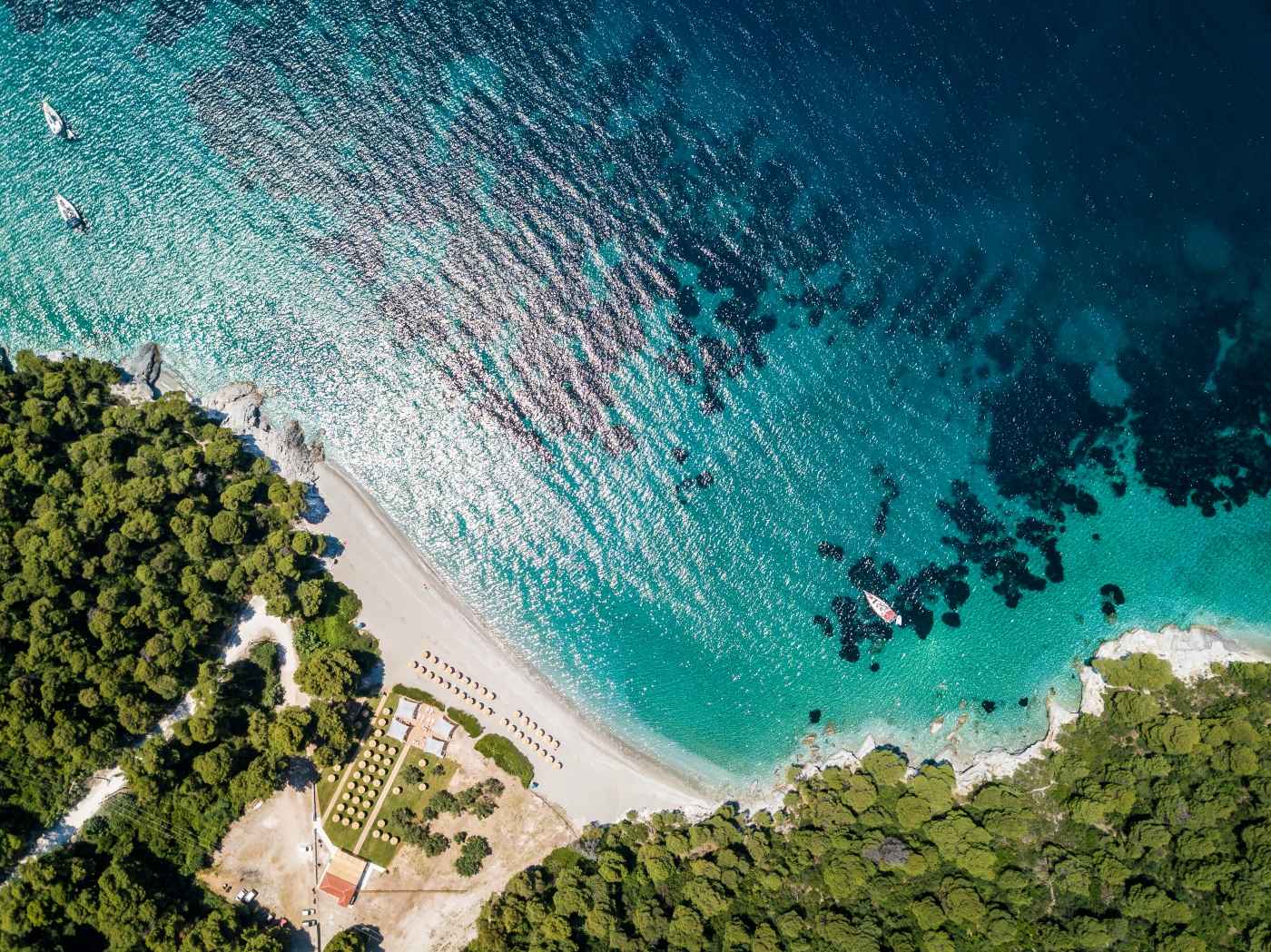
Skopelos is one of those Greek islands that can still surprise its visitors, not because it is still unknown – quite the opposite, the film Mamma Mia! made it famous all over the world – but because most of what makes it truly special is only discovered when you begin to explore it slowly, and little by little it wins over those who, whether by chance or by choice, have decided to visit it.
Skopelos is an island of authentic Greece, natural and welcoming just as it once was, with its clear air scented with pine resin, salt and summer.
Here, greenery is not simply a backdrop; it is an integral part of the landscape. Forests cover most of the island, pine trees descend along the hills until they almost touch the waters of the Aegean, ancient paths cross remote rural areas and enchanting monasteries hidden among the vegetation, while along the coast there is an endless succession of turquoise bays, pebble beaches, tiny coves and cliffs.
Compared with the neighbouring island of Skiathos, Skopelos has a completely different rhythm. With no airport, everything feels much more understated, nightlife is more restrained and tourism tends to be less intrusive. This very characteristic has allowed the island to preserve a particularly authentic and still genuinely Greek atmosphere.
You can spend the morning wandering in complete relaxation through the alleys of the Chora, reach a pine-fringed beach in the afternoon and bask in the sun, watch a magnificent sunset from Milia and end the day in a small taverna savouring the delicacies of Greek cuisine. Or forget for a while that you are on a seaside holiday and venture along mountain trails, following ancient rural paths between monasteries and old kalyvia, the island’s traditional country houses.
Skopelos Town, or simply Chora, is considered one of the most beautiful settlements in the Sporades.
The town rises amphitheatrically around the harbour and gradually climbs the hillside. Seen from the sea, it looks like a mosaic of white houses, red-tiled roofs, wooden balconies, tiny churches and patches of vegetation, almost like a naïve painting.
Unlike the celebrated villages of the Cyclades, white is not the predominant colour in the landscape here. The architectural character of Skopelos is more complex: stone, tiles, balconies, wood and warmer colours make the town instantly recognisable and surround it with a warm and inviting atmosphere.
The harbour is the heart of everyday life. In the morning ferries, boats and excursion vessels arrive and depart, while as the day progresses the waterfront gradually fills with cafés, tavernas and people simply enjoying their time.
But the real Chora begins as soon as you leave the harbour and climb into its narrow streets, which become a small maze of stairways, houses, hidden flower-filled courtyards and ancient churches. Some passages are so narrow that they almost seem like private alleyways. Lose yourself in these little corners of paradise, leave the main streets behind and wander wherever curiosity takes you; at worst, you will eventually find yourself back where you started…
In the upper part of the Chora lie the remains of the Kastro, the ancient fortified area where local inhabitants sought refuge during attacks by invaders.
Its position, of course, is no coincidence. Medieval fortifications were often built by making use of even older structures and subsequently enlarging them. The Kastro of Skopelos was expanded during the period of Venetian rule.
In ancient times the island was called Peparethos and had three main fortified cities: Peparethos, Panormos and Selinous. The city of Peparethos continued to develop in the area of today’s Chora, and its ancient defences were reused over the centuries. Sections of the Byzantine and Venetian walls can still be seen in the upper part of town, where, incidentally, you can enjoy an incredible panorama, looking across the rooftops towards the harbour, the surrounding hills and the sea.
At sunrise especially, but also at sunset, the spectacle becomes even more beautiful.
Near the end of the harbour stands one of the most iconic sights of Skopelos Town, Panagitsa tou Pyrgou, the small white church built on a rocky outcrop. A short flight of steps leads to one of the most beautiful viewpoints in the capital.
Seen from the harbour, the church appears almost suspended above the houses. Once you reach it, however, it is the harbour itself that becomes the star of the show.
It is undoubtedly one of the best places to begin or end a walk through the Chora.
The history of Skopelos is far older than its modern image associated with holidays and cinema.
In ancient times the island was known as Peparethos. Tradition tells that it was colonised by Cretans led by Stafylos, son of the god Dionysus and Ariadne, daughter of Minos. The connection with Dionysus is no coincidence: in antiquity Peparethos was also famous for its wine, which was traded and known far beyond the island.
Important Mycenaean finds have been discovered at Stafylos. In 1936, a rich tomb was uncovered containing pottery, weapons and an extraordinary golden sword hilt. Archaeologist Nikolaos Platon suggested that the tomb may have belonged to a Mycenaean ruler and symbolically associated it with the mythical Stafylos.
This story makes Stafylos Beach much more interesting than it might appear if considered simply as a seaside destination.
Skopelos subsequently passed through Roman, Byzantine, Venetian and Ottoman periods and, like almost all the islands of the Aegean, also experienced times marked by pirate raids and harsh foreign domination.
The fortifications, monasteries and numerous small churches scattered across the island still tell the story of this long history today.
The first important thing to know about Skopelos is very simple: the island does not have an airport.
And perhaps this very characteristic has helped keep the island less developed in terms of tourism compared with Skiathos.
The most commonly used option is to fly to Skiathos International Airport (JSI) and then continue by ferry.
Depending on the service, ferries may arrive at:
This detail is important because the two ports are located in different parts of the island and can also influence how you organise your holiday.
Skopelos is also connected with Volos, on the Greek mainland.
This option can be particularly interesting for travellers arriving from Thessaloniki or mainland Greece, or for anyone wishing to create a broader itinerary that also includes the beautiful gulf where the city of Volos is located.
There are also connections from Mantoudi, on the island of Evia.
Availability, timetables and frequency vary according to the season, so it is essential to check your arrival port before booking your accommodation.
If you arrive on an international flight to Skiathos and need to continue to Skopelos, avoid booking a ferry that leaves too soon after your flight is scheduled to land. Sea conditions or even a simple flight delay can completely disrupt your plans and force you to reorganise everything while you are already on holiday – not exactly the most pleasant way to begin your trip.
For Skiathos + Skopelos + Alonissos itineraries, organising ferries and accommodation correctly makes a huge difference.
Skopelos is not large, but it is definitely more mountainous and rugged than it appears on a map, and continuous climbs and descents are part of the landscape.
Distances are not particularly long; however, the roads follow the contours of the island and often cross hilly areas that can sometimes be slightly challenging.
For those who want to explore Skopelos freely, a car is probably the best choice.
It allows you to reach practically everywhere, from the most remote beaches to the opposite ends of the island.
Be careful on some secondary roads and those leading to more isolated places, as they can be narrow or unpaved, so caution and attentive driving are essential.
These are particularly popular with couples and younger travellers, but be careful: beautiful Skopelos requires greater attention than flatter islands precisely because of its landscape, with climbs, unexpected bends, dense vegetation and gravel.
In this case, previous experience driving the vehicle is essential!
During the tourist season the public transport service works reasonably well, and connections between the capital and the rest of the island are fairly convenient. We could say that it is sufficient if your curiosity does not extend much beyond the main beaches.
If, on the other hand, your idea of exploring includes the island’s beautiful monasteries or more remote areas, only the independence provided by a car, motorbike or quad will truly allow you to satisfy your curiosity.
Here too, the sea offers a completely different perspective. After all, approaching an island from the water always provides a different – and undoubtedly better – perception and understanding of it.
Excursions and small boat tours allow you to reach less accessible bays and admire a coastline almost continuously covered in vegetation, creating an unforgettable palette of colours.
Choosing where to stay in Skopelos is particularly important because the different areas of the island offer very different experiences. So, unless you are one of those travellers who simply love adventure and are happy to take things as they come, when planning a holiday on an island like Skopelos it is important to choose the location that best suits your needs.
Panormos
One of the most convenient areas. The beach, tavernas and services are all within easy reach.
Neo Klima – Elios
A modern location and relatively flat compared with other parts of the island. A good base for reaching several beaches on the western coast.
Skopelos Town
Convenient for services, restaurants and transport connections, especially if you do not want to depend constantly on a car.
Recommended accommodation types:
Skopelos Town
Perfect if you want evening walks, tavernas and atmosphere.
Panormos
Excellent for those who want to stay close to the sea.
Glossa
More romantic, panoramic, traditional and peaceful for a completely relaxing holiday.
Neo Klima
An interesting option for quickly reaching Kastani, Milia and Hovolo.
Skopelos is certainly not an island dedicated to intense nightlife. In fact, if you are imagining wild nights out, you have definitely chosen the wrong destination.
For those who still want to go out in the evening, Skopelos Town is undoubtedly the best base.
This is where you will find most of the:
Skopelos is beautiful, but choosing the right accommodation requires some care. Many properties in the Chora are located on uphill streets or can only be reached via steps that can sometimes be rather steep and difficult, so they should be avoided if you have mobility problems.
Before booking, it is important to check:
The Chora deserves more than just one visit; to really get to know it, you need to return several times. It is a town that feels slow and authentic in the morning, almost seems to fall asleep in the afternoon – because rest is important and good for everyone – and then dresses differently in the evening, becoming elegant and lively enough to tempt you to stay out late.
Do not limit yourself to the waterfront, although it is undoubtedly beautiful and pleasant with its sea breeze and choice of venues. Climb up to the Kastro, stop to admire the old houses, step inside the small churches when they are open and venture into streets where there are no shops, where around a corner it almost feels as though a ghost might suddenly appear. Lose yourself in this magical maze of alleyways.
Skopelos Town also preserves several buildings and museums dedicated to local culture, including the Folklore Museum, the Vakratsa Mansion and the house of Pavlos Nirvanas, now a historical museum – excellent alternatives to a day at the beach.
Glossa is the island’s second most important settlement and one of the places most likely to surprise first-time visitors to Skopelos. Built amphitheatrically above the port of Loutraki, on the north-western side of the island, its houses seem to rest one above another on the hillside, while incredible views of the Aegean continually appear between its narrow streets.
Alexandros Papadiamantis, the great and famous writer from Skiathos, described it as a “high village” precisely because of its position, which is also what makes it so special.
Walking through Glossa means tackling plenty of climbs and steps, but also discovering traditional houses, flower-filled balconies, old doorways and a way of life that is decidedly less touristy and more genuine than in the Chora.
The ideal time to visit Glossa is late afternoon, when the heat becomes less intense and the sun begins to descend towards the sea, creating breathtaking views as the colours continuously change.
Immediately below beautiful Glossa lies Loutraki, one of the main ports of Skopelos. You may arrive here directly from Skiathos, but it is much more than simply a point of arrival. The area offers archaeological evidence connected with ancient Selinous, one of the three cities of ancient Peparethos, as well as remains from the Roman period.
It is a perfect example of how, in Skopelos, centuries of history are often hidden behind places that at first glance appear quite simple.
Between Glossa and Neo Klima lies Paleo Klima, the old village of Klima. Located in the north of the island and far from the most visited areas, it is undoubtedly one of the most interesting corners of the Sporades, revealing a completely different side of the archipelago. Houses frame the mountainside, offering beautiful views over the sea, while the quiet atmosphere tells the story of a simple, traditional way of life.
The name literally means “Old Klima” and distinguishes the ancient settlement from nearby Neo Klima, also known as Elios. Palio Klima was severely damaged by the earthquake that struck Skopelos in 1965, and many residents subsequently decided to move closer to the coast. Over the years, many houses have been restored while still preserving the simple and characteristic appearance of the village.
One of the best times to visit is late afternoon. Its panoramic position offers particularly beautiful sunsets, when the light slowly changes colour and the sea takes on golden shades. It is the ideal place for those who love landscape photography, leisurely walks or simply stopping for a while to admire the view.
All the beaches of Skopelos share one characteristic that makes them immediately recognisable: the contrast between greenery and sea.
It is not unusual to see trees stretching almost all the way down to the beach, while the sea changes colour from emerald green to the classic and unmistakable blue of the Aegean.
Stafylos is one of the best-known beaches and one of the closest to the Chora, just over 4 km away. It is organised and lies within a sheltered bay surrounded by vegetation. But its importance extends beyond the sea. Its name recalls the mythical Stafylos, and important Mycenaean remains were discovered on the peninsula separating this beach from Velanio.
Beyond the headland at the end of Stafylos Beach lies Velanio. Its name is said to derive from the presence of a cave at one end of the beach containing water, which is thought to have been used as ancient baths, hence the connection with the Greek word valaneion (baths).
Velanio is officially a naturist beach, although it is also frequented by non-naturist bathers.
Agnontas is one of the island’s most pleasant small harbours. The bay is sheltered and surrounded by greenery. An interesting historical curiosity concerns its name, which is said to be connected with the athlete Agnon, a native of ancient Peparethos and winner at Olympia in the 6th century BC, one of the island’s earliest historically documented figures. Today Agnontas is above all the ideal place to stop for lunch or dinner by the sea. The tavernas close to the water make this small bay particularly enjoyable in the evening.
Limnonari lies within a very well-protected bay. Its name may derive from the calm appearance of the sea, resembling a small lake; another tradition, however, connects it with the god Ares. Pale sand and turquoise water create a landscape quite different from many of the island’s predominantly pebbly beaches. It is particularly suitable for anyone looking for calm water and a relaxing day.
Not far from Agnontas lies one of the landscapes that has become a symbol of Skopelos: Amarantos. The coastline consists of white rocks, small access points to the sea and pine trees growing literally above the cliffs. It is one of the places where the famous meeting of “green and blue” undoubtedly reaches its most spectacular expression. Some views from this area also appeared in Mamma Mia!.
Panormos is one of the island’s best-known and most famous beaches. The bay is wide, the sea becomes deep quite quickly and tavernas and accommodation can be found directly behind the beach. It is also one of the easiest areas for anyone wishing to stay close to the sea. Panormos, however, also has historical importance: in ancient times it was one of the island’s three principal cities.
Milia Beach is considered by many to be one of the most beautiful beaches in Skopelos. It is wide, organised and characterised by small pebbles and exceptionally clear water. A pale rock formation visually divides the beach into two sections and makes the landscape particularly distinctive.
Milia is also one of the best places to watch the sunset in Skopelos. Arriving in the afternoon and staying until the final hours of daylight is probably the best way to experience it.
Few names are as closely associated with Skopelos as Kastani Beach. It was one of the main locations used during the filming of Mamma Mia!, and some of the movie’s best-known scenes were shot right here.
The beach is surrounded by pine trees, the sea takes on turquoise shades and its position on the western coast creates a particularly beautiful landscape. The best times to experience a different, quieter Kastani are early in the morning or during the final hours of the afternoon before sunset.
Hovolo is one of the beaches that most often surprises those exploring Skopelos. Located near Neo Klima, it is characterised by towering pale cliffs, vegetation and turquoise water which, contrasting with the white rocks, creates one of the most beautiful and distinctive landscapes on the western coast.
To reach some sections of the beach you may need to walk along the shoreline and, at certain points, step slightly into the water, but it is a very pleasant route.
Neo Klima, also called Elios, is one of the island’s more modern settlements. The village was established following the 1965 earthquake that struck the Paleo Klima area and prompted part of the population to move closer to the coast. Today it is an excellent base for anyone wishing to explore western Skopelos.
The northern coast is less frequently visited, ideal for true explorers and decidedly wilder. Here even the road itself becomes part of the experience of discovering the island.
Small stretches of coastline and panoramic viewpoints reveal a very different face compared with the more organised bays of the western coast.
Perivoliou Beach is one of the beaches to choose if you want to get away from the island’s best-known destinations.
The coastline is more exposed, the landscape more dramatic and rocky cliffs accompany the descent towards the sea. It is important to always consider wind conditions, as this part of the island is more exposed.
Among the things you absolutely must see in Skopelos, Agios Ioannis – Ai Giannis Kastri occupies a special place. The tiny chapel stands on top of an enormous rocky outcrop rising directly from the coast. To reach it you must climb 106 steps. The rock rises approximately 100 metres above the sea, and from the top there is an extraordinary view over the northern coastline.
The location became famous worldwide thanks to Mamma Mia!, where it was used for the wedding scene.
According to tradition, a fisherman saw a light on the rock for several nights. After dreaming of a woman who told him about the presence of an icon, he climbed to the top and discovered an image of Saint John the Baptist. He took the icon away, but mysteriously it continued to return to the rock.
The fisherman eventually understood that the icon “wanted” to remain there, and the chapel was built. It is one of the island’s most beautiful legends and makes a visit far more interesting than the cinematic connection alone.
And here we are, right at the true soul of Skopelos, because this is where the island reveals its most authentic character.
Its interior is an endless succession of forests, orchards, olive groves, rural houses and ancient paths. As of this year (2026), the Skopelos Trails network has officially been established, comprising well over 110 km of trails following historic routes that for centuries connected villages, agricultural areas and monasteries. It is a genuine journey back in time, moving from one landscape to another and revealing a side of Skopelos that remains almost hidden.
This is particularly interesting because it means that Skopelos is not simply an island where “you can go hiking”.
It is a genuine hiking destination.
The routes connect, among others:
Opposite the Chora rises Mount Palouki, one of the island’s most fascinating areas. Here you will find an incredible concentration of monasteries and small churches immersed in the forest. It is a route that brings together those who love trekking and those who simply want to be alone with their thoughts and follow a more spiritual path.
The Evangelistria Monastery was built in 1712 over the remains of an earlier Byzantine monastery. The complex has an almost fortified appearance and occupies a panoramic position above Skopelos Town. Inside are preserved an important iconostasis, an 18th-century episcopal throne and ancient icons, including a Panagia Pammakaristos dating from between the 15th and 16th centuries. The view over the Chora from the monastery area is one of the most beautiful on the island.
The Monastery of Timios Prodromos is another of the most important stops in the Palouki area. Surrounded by greenery and connected with the other religious complexes by old paths, it helps visitors understand just how important the monastic tradition has been throughout the island’s history. It is no coincidence that Skopelos is remembered as the island of 365 churches, one for every day of the year.
Agia Varvara is considered one of the oldest monasteries in Skopelos. Its fortified appearance recalls the periods when monasteries and religious communities had to protect themselves against raids and marauders. Visiting these places on the same day creates one of the island’s most fascinating excursions and will leave you with an incredible sense of enrichment.
One of the most curious and lesser-known places in Skopelos is Sentoukia. The name literally means something similar to “chests” or “trunks” and derives from popular legends that associated these large structures carved into the rock with hidden treasures and pirates.
In reality, they are four ancient tombs, probably dating from the Roman or Early Christian period, carved directly into the rock of Mount Karya. Reaching them requires a fairly long walk and they are not an easy destination, but perhaps this is precisely what makes them so interesting.
This is not a conventional archaeological site with a ticket office, museum and organised visitor route; these are ancient remains immersed in the landscape.
Sentoukia also offers a beautiful view over the sea.
At the northernmost end of the island stands the Gourouni Lighthouse, built in 1889. Its stone tower is approximately 14 metres high and, including the lantern, reaches almost 18 metres.
An interesting curiosity concerns the material used in its construction: part of the structure was built using porous volcanic stone that probably came from Kimolos.
The lighthouse was automated at the end of the 1980s and is now classified as a historical monument.
Reaching it from Glossa also involves travelling along an unpaved road.
It is one of the most unusual excursions for anyone wishing to discover the less photographed side of Skopelos.
Skopelos Town changes completely before visitors begin returning from the beaches. The streets are almost empty, shops are just opening and the harbour still belongs mainly to local residents. It is the best time to photograph the town and observe its authentic everyday life.
Milia is already beautiful during the day, but late afternoon completely changes the atmosphere of the beach. The sun descends towards the horizon in front of the western coast and the sea takes on increasingly deep shades.
The 106 steps are definitely more pleasant in the morning. Arriving early also means encountering fewer people and being able to enjoy the panorama in greater peace.
Even those who are not serious hikers should dedicate a few hours to the trails. It is the best way to understand just how integral the forest is to the identity of Skopelos.
These three beaches are relatively close to one another but completely different. Milia is wide and scenic, Kastani is more famous and lively, while Hovolo is more intimate and distinctive.
Dinner at a table close to the water is one of the simplest yet most enjoyable experiences on the island.
Arrive in the late afternoon, wander through the village streets and stay until sunset. It is likely to be one of the evenings you remember for the longest time.
It is impossible to talk about Skopelos without mentioning Mamma Mia!. Most of the exterior scenes in the 2008 film were shot right here.
The most famous locations include:
The gastronomy of Skopelos deserves a much larger section than the usual list of Greek dishes.
The island traditionally produces:
and has a long tradition connected with wine, which was already famous in antiquity as Peparethos wine.
The undisputed queen of local cuisine is the Skopelitiki tyropita, the traditional Skopelos cheese pie. This is not the classic rectangular pie baked in the oven.
The pastry is rolled into a spiral, traditionally filled with goat’s cheese and fried in oil.
Its spiral shape makes it instantly recognisable and it has become one of the island’s signature dishes.
Plums are historically one of the island’s most important products. They are also used in savoury cooking as well as desserts.
A dish less familiar to tourists is rofos stifado, grouper prepared using the traditional stifado cooking method. It is an interesting example of the meeting between seafood cuisine and local home cooking.
Also worth trying:
Skopelos is not Skiathos and it is certainly not Mykonos; evenings here are much more relaxed.
In Skopelos Town you will find:
Evening life is mainly about strolling, dining and enjoying a drink. For many people, this is precisely one of the reasons for choosing the island.
Skopelos can be an excellent destination for families, especially for those looking for a peaceful holiday.
The main advantages are:
The most convenient areas are:
With small children, however, remember that many beaches are pebbly and some locations involve hills or steps.
Couples are probably one of the island’s ideal types of visitors.
Skopelos offers:
For a romantic holiday, I would particularly recommend:
It is the easiest island to combine with Skopelos. Skiathos offers a livelier atmosphere, numerous sandy beaches and a more cosmopolitan Chora.
It is probably the most interesting combination for nature lovers. Alonissos is associated with the National Marine Park of the Northern Sporades and has an even more peaceful character.
A boat trip along the coastline of Skopelos allows you to see bays and cliffs that are difficult to fully appreciate from land.
• Best period: May–September. June and September probably offer the best balance between weather and tranquillity.
• July and August: busier, especially Kastani, Milia and Ai Giannis.
• Car: strongly recommended if you really want to explore the island.
• Shoes: do not bring only flip-flops. Trails, monasteries and villages require comfortable footwear.
• Sea: some beaches become deep quite quickly.
• Wind: the northern coast can be more exposed.
• Ferries: always check your arrival port because you may arrive at Skopelos Town or Loutraki/Glossa.
• Trekking: the new official network includes more than 110 km of trails; in summer always carry water, a hat and sun protection.
• Monasteries: wear respectful clothing and behave discreetly.
• Ai Giannis: it is best visited in the morning or late afternoon to avoid the heat and crowds.
For a first holiday, we recommend at least 7 days.
In one week you can:
With 10–14 days, Skopelos can be perfectly combined with Skiathos or Alonissos.
Skopelos is not the island for those looking only for beach clubs and nightlife. It is an island to choose if you want to wake up surrounded by greenery, if you love walking through forests that seem almost enchanted, if you are fascinated by ancient monasteries with their subtle aura of mystery, and if you prefer a beautiful taverna by the sea to a glamorous venue.
This is what the island of Skopelos can give you: moments of silence, mystery and an incredible abundance of nature.
Choosing Skopelos is easy, while choosing the right Skopelos for the way you like to travel requires a little more attention.
A family with children will have different needs from a couple looking for seclusion and sunsets; those who want to go trekking will need to organise their holiday differently from those who want to spend every day on the beach.
And anyone wishing to combine Skopelos + Skiathos + Alonissos will need to carefully coordinate flights, ferries, ports and transfers.
For this reason, a holiday can be planned around:
It is not simply about getting to Skopelos; it is about understanding which part of Skopelos is right for you.
Because this island can be romantic, wild, family-friendly, cultural or completely relaxing.
It all depends on how you choose to experience it.
Write to us at info@meraviglioseisolegreche.com and tell us how you imagine your holiday in Skopelos.
We can turn it into a journey designed around your own way of experiencing the Sporades.





Pianifica la tua vacanza nelle isole greche
Niente pacchetti standard. Contattaci per un itinerario su misura che cattura l'anima delle isole.
Massimo 2 preventivi gratuiti
Dalle acque cristalline di Mykonos ai tramonti mozzafiato di Oia, il nostro team di esperti locali è pronto a curare ogni dettaglio della tua fuga greca. Non siamo solo un'agenzia — siamo il tuo ponte verso l'Egeo.
Risposta immediata garantita