★★★★★
257 Reviews
Leggi tutte


Skiathos is not just a beach destination: it is an island that slowly wins you over, with the intense scent of pine trees reaching almost to the sea, the golden light that envelops the harbour at sunset, the sound of boats returning in the evening and the incredible colour of the water, constantly changing from turquoise to deep blue.
It is one of the greenest islands in Greece and one of the most fascinating in the Northern Sporades. The island covers just 48 km², yet it offers a surprising variety of landscapes: gentle hills, hidden bays, golden sandy beaches and headlands offering breathtaking views. The coastline alternates between secluded coves accessible only by sea and long sandy shores, perfect for those looking for relaxation or water sports.
Surprisingly rich in experiences, Skiathos combines spectacular beaches, nature, history, nightlife, small monasteries, hiking trails, traditional cuisine and an elegant yet never excessive atmosphere.
Here you can spend the morning on an organised beach, have lunch in a seafront taverna, walk through a pine forest in the afternoon and end the day strolling through the narrow streets of Skiathos Town.
It is precisely this ease of getting around that makes the island perfect for so many different types of travellers.
Families with children, couples, young people, groups of friends and senior travellers can all easily find their ideal corner of the island.
Skiathos is also the natural gateway to the Sporades. From here, you can easily reach Skopelos and Alonissos, transforming a simple holiday into an itinerary through some of the greenest and most enchanting islands in Greece.
The “perfect island in miniature”: large enough to offer every kind of experience, yet compact enough to be explored in just a few days, always with the scent of pine trees in the air.
Let’s discover everything that makes Skiathos so special.
Skiathos Town, also known as Chora, is the heart of the island. It is built along a natural bay and develops around the harbour, which has always been the centre of Skiathos’ economic and social life.
White houses with tiled roofs, flower-filled balconies, small churches, pedestrian streets and terraces overlooking the sea create a typically Greek atmosphere, yet one that is very different from that of the Cyclades.
Here you will not find the arid landscape of Mykonos or Santorini. Skiathos is green, pine trees surround the town and constantly approach the coastline. During the day, the harbour is bustling with boats departing for Lalaria, Skopelos, Alonissos and tours around the island. In the evening, everything changes.
The streets fill with people, restaurants turn on their lights, terraces become the perfect place for an aperitif and the waterfront transforms into one of the liveliest spots in the Sporades. Despite this, Skiathos Town still retains peaceful corners. Just move slightly away from the harbour to rediscover quiet alleys, small traditional houses and little churches mainly frequented by local residents.
The history of Skiathos is much older than you might imagine when looking at its beaches and lively venues today. The island has been inhabited since ancient times and occupied a strategic position along the routes of the northern Aegean.
Skiathos has an ancient and fascinating soul. Founded in the 9th century BC by the Pelasgians, it was later inhabited by Athenians and Romans, becoming an important commercial and strategic port.
Legend has it that the Argonauts, during their expedition in search of the Golden Fleece, landed here to rest and replenish their supplies. According to mythology, even the gods loved the tranquillity of this sun-drenched land.
During the Persian Wars, Skiathos became involved in the conflicts between the Greek world and the Persian Empire. Over the following centuries, it came under several different rulers, including the Romans, Byzantines and Venetians.
During the Middle Ages, the island suffered pirate raids, and to defend themselves the inhabitants took refuge in Kastro, a fortified village perched above a spectacular cliff: today one of the most fascinating places to visit.
Later, during Ottoman rule, Skiathos became a refuge for Greek monks and patriots, and after the Greek War of Independence the inhabitants returned to live in the area of present-day Skiathos Town. The island also played an important role in the birth of modern Greece. The Monastery of Evangelistria, which can still be visited today, was the birthplace of the first Greek flag, sewn here in 1807.
Every stone in Skiathos tells a story, and walking through the narrow streets of the historic centre feels like stepping between myth and reality.
According to some traditions, the name Skiathos may derive from the Greek words skia (shadow) and Athos, referring to the shadow of Mount Athos which, according to legend, could extend as far as the island.
Other interpretations instead connect the name to the abundance of forests and therefore to the shade created by the trees. Whatever its true origin, the connection between Skiathos and nature remains one of the island’s most distinctive features.
Skiathos is one of the easiest Sporades islands to reach thanks to its international airport.
Skiathos Alexandros Papadiamantis International Airport (JSI) is located just a few kilometres from Skiathos Town. During the summer season, numerous direct flights are available from several European cities, as well as connections with Athens. The airport has also become famous among aviation enthusiasts because the runway is very close to the coast and aircraft pass at low altitude during landings and take-offs.
From the terminal, Skiathos Town can be reached in just a few minutes by:
Skiathos is connected by sea mainly with mainland Greece and the other Sporades islands.
The main ferry connections allow you to reach:
Schedules and frequency vary depending on the season. For travellers wishing to visit several islands, Skiathos is one of the best starting points for an island-hopping itinerary through the Sporades.
If you want to combine Skiathos + Skopelos + Alonissos, organise your flights, ferries and accommodation in advance. Distances between the islands are relatively short, but ferry schedules need to be carefully coordinated.
Skiathos is small, but choosing the right means of transport can completely change your holiday. The southern part of the island is the easiest to explore. A main road connects Skiathos Town with numerous beaches all the way to the Koukounaries area.
This is the best solution for those who want to explore the island without depending on timetables. It allows you to reach less crowded beaches, monasteries, panoramic viewpoints and inland areas. Some secondary roads may be unpaved.
These are widely used, especially by couples and young travellers. They are practical for short journeys, but it is important to have driving experience and to be careful on narrower or unpaved roads.
The main bus route connects Skiathos Town with the resorts along the southern coast. It is a convenient solution for those staying in this part of the island. Bus stops are traditionally identified by numbers and include many of the best-known beaches.
Taxis are particularly convenient in the evening or for airport transfers.
In Skiathos, boats are almost an alternative means of transport. Many excursions allow you to reach beaches and stretches of coastline that are difficult or impossible to access by land. Lalaria is the most famous example.
Choosing the right area is essential. Although Skiathos is a small island, it offers very different atmospheres.
Troulos
A green, peaceful area close to a sandy beach. There is a good selection of tavernas and services.
Koukounaries
Perfect for those who want to stay close to some of the most beautiful beaches on the island. A green and relaxing area.
Agia Paraskevi
A good balance between beach, services and tranquillity.
Achladies
Convenient for reaching Skiathos Town and suitable for families who want to combine beach time with evening strolls.
Recommended types of accommodation:
Skiathos Town
The best choice for those who want to enjoy the island’s nightlife. Restaurants, cocktail bars, entertainment venues and the harbour are all within walking distance.
Megali Ammos
Very close to both the town and the beach.
Vromolimnos
An area known for its livelier atmosphere.
Recommended types of accommodation:
Kanapitsa
Elegant, scenic and quieter.
Agia Paraskevi
Beach, greenery and romantic tavernas.
Skiathos Town
Perfect for couples who enjoy evening strolls and dining by the harbour.
Koukounaries
Ideal for those who place the sea and nature at the top of their priorities.
Recommended types of accommodation:
Skiathos Town
Perfect for combining excursions, restaurants and evenings out.
Troulos
A strategic base for exploring the coast.
Agia Paraskevi
An excellent balance between tranquillity and services.
Recommended types of accommodation:
Skiathos Town
Convenient for services, restaurants and walks.
Agia Paraskevi
Well organised and close to the beach.
Troulos
Peaceful and pleasant.
Tip: before booking, always check for hills, steps and the actual distance from the beach, as several areas of Skiathos are hilly.
To truly understand Skiathos, you should begin with its Chora, Skiathos Town, because this is where the island reveals both its liveliest and its most traditional character. The town develops around the natural harbour and gradually climbs inland through a maze of narrow streets, stairways and small pedestrian passages. Seen from the sea, it appears as a compact cluster of light-coloured houses, tiled roofs, patches of greenery and boats moored along the coast, an image very different from the minimalist, almost entirely white landscape of the Cyclades. You are in the Sporades, and you immediately realise it: vegetation is an integral part of the urban landscape too.
The beauty of Skiathos Town lies precisely in its constantly changing atmosphere. Along the waterfront there are restaurants, cafés, excursion boats and an energy that increases as the hours pass, while walking just a few streets uphill leads to much quieter corners. Here you will find small churches, hidden courtyards, flower-filled balconies and old houses that remind you that, long before becoming one of the best-known tourist destinations in the Sporades, Skiathos was above all a community of sailors, fishermen, craftsmen and families deeply connected to the sea.
The present-day town is also closely linked to the history of Kastro, the ancient fortified settlement on the northern coast. For long periods, the island’s inhabitants were forced to move away from the more accessible coastline to protect themselves from raids coming from the sea. When conditions changed, the population gradually returned to the area of today’s Chora and the harbour resumed its natural role as the centre of island life.
For this reason, Skiathos Town deserves more than just an evening stroll. We recommend returning at different times of the day. Early in the morning, it belongs almost entirely to the locals: shutters are raised, the first coffees are served, boats prepare to depart and the noise of suitcases and visitors still leaves room for the sounds of everyday life. In the evening, however, the same town changes its face and becomes elegant, bright and lively.
The Old Port is one of the places where this transformation can be felt most clearly. During the day it is a departure point: boats and excursions leave their moorings for Lalaria, Kastro, Skopelos, Alonissos and the bays scattered along the coastline. In the morning there is a constant movement of crews, small fishing boats, tourists and vessels preparing to head out to sea.
But seeing the harbour only as a departure point for excursions means missing an important part of Skiathos’ history. For generations, the sea meant work, a connection with the outside world and a means of survival. The island developed a strong maritime and shipbuilding tradition, and its vessels sailed far beyond the boundaries of the Sporades. This identity can still be felt when observing the harbour during its quieter hours, when behind the tourist image emerges that of a small island community that grew up looking towards the sea.
After sunset, the Old Port completely changes personality. Boats return, lights reflect on the water and evening strolls begin. This is the time to choose a taverna, stop for a drink or simply sit and watch the activity around you. One of the most characteristic sights in the evening is the stairways transformed into original outdoor spaces, with tables and seating following the natural slope of the town.
If you want to see a completely different harbour, however, come here very early. When the excursion boats have not yet departed and most visitors are still having breakfast, the Old Port retains that simple atmosphere that makes it easier to imagine the Skiathos of the past.
Continuing along the harbour, you reach Bourtzi, the small green peninsula separating the Old Port from the New Port. At first glance, it may simply seem like a beautiful pine-covered area where you can walk in the shade and admire the town from a different perspective. In reality, it is one of the places where the history of Skiathos has left particularly interesting traces.
Its position extending into the sea once made it an ideal location for defending the harbour, and a fortification was built here during the Venetian period. Over the centuries, Bourtzi’s function changed several times: from a defensive point it became a space used for public purposes and, at the beginning of the 20th century, a school building was also constructed here. Today that same place has become a cultural space, creating an unusual connection between medieval Skiathos, the island of the last century and contemporary life.
Walking along Bourtzi means having the sea almost constantly beside you. Pine trees create natural shaded areas, glimpses of boats continually appear between the branches and, turning towards the Chora, you can clearly understand how the town developed around its two harbours.
It is a place to enjoy without rushing. Stop for a few minutes instead of simply crossing it to take a photograph. Late afternoon is probably the most atmospheric time: the heat begins to ease, the colour of the sea becomes deeper and Skiathos Town slowly starts to switch on its lights.
Bourtzi also preserves part of the island’s maritime heritage through a museum space dedicated to local nautical and cultural traditions. It is an interesting visit, especially for those who want to understand why the relationship between Skiathos and its boats runs much deeper than modern tourism.
Few places allow you to enter the soul of the island quite like the House of Alexandros Papadiamantis. Born in Skiathos in 1851, Papadiamantis is one of the most important figures in modern Greek literature, and his relationship with the island was so profound that even today his name constantly accompanies those walking through the Chora.
His house should not be imagined as a large monumental museum. It is precisely its intimate and simple character that makes it special. The rooms tell the story of a daily life far removed from luxury and allow visitors to approach the world in which the writer lived and from which he drew inspiration.
In his stories, Skiathos is not a postcard backdrop. It is made of people. Sailors, fishermen, priests, women, families, the poor, workers and ordinary characters from everyday life become the protagonists of an island world where the sea, religion, hardships and traditions shape existence.
Learning about Papadiamantis before continuing to explore the Chora almost allows you to see it through different eyes. Churches, narrow streets and old houses stop being merely picturesque features and become fragments of a society that shaped the identity of the island.
The main pedestrian street also bears his name, an everyday presence that shows just how deeply Papadiamantis remains connected to the memory of Skiathos.
Gradually leaving the harbour behind and climbing through the narrow streets of the Chora, you reach one of the most beautiful viewpoints in town: the Church of Agios Nikolaos.
Saint Nicholas is traditionally the protector of sailors, and the presence of a church dedicated to him above a town that lived from the sea for centuries carries a meaning that goes beyond religion. From up here, the harbour almost seems to rest under his protection.
The climb is short, although during the hottest summer hours it can feel demanding. It is absolutely worth the effort.
Once you arrive, the view completely changes your perception of the town. From above you can distinguish Bourtzi, the two harbours, the rooftops of the Chora, the boats and the outline of the coastline. It is one of the best places to understand just how physically connected Skiathos Town is to the sea.
Beside the church, the distinctive clock tower has become one of the town’s most recognisable landmarks. The viewpoint is particularly beautiful in the late afternoon, when the sun is no longer directly overhead and the light softens the colours of the houses and harbour.
Do not leave immediately after taking your photograph. Stop.
Watching the boats enter and leave the harbour from above, while the sounds of the town reach you softened by the distance, is one of those small moments that often remain more vivid in your memory than the attractions you had planned to visit.
Returning towards the heart of the town, you enter the small maze of the pedestrian streets of the Chora.
Papadiamanti Street is the best-known and busiest street. Boutiques, shops, bars, ice-cream parlours and numerous businesses are concentrated here, and it is practically impossible to spend a holiday on the island without walking along it several times.
But the most interesting side of Skiathos is not necessarily found on the main street.
Every now and then, turn down a street without knowing exactly where you are going.
The side streets are narrower, some climb uphill, while others suddenly descend towards the sea. Around a corner you may find a tiny chapel, a staircase decorated with flowerpots, an old wooden doorway or a traditional house with its characteristic tiled roof.
And it is precisely by observing these houses that you notice one of the most obvious differences compared with the Cyclades. Skiathos is not built solely around the contrast of white and blue: stone, wood, roof tiles, vegetation and warmer colours all form part of the architecture of the Chora, giving it a typically Sporadic character.
During the day, the streets mainly serve a commercial purpose. When evening arrives, they change. Tables occupy small spaces between the buildings, different aromas drift from the kitchens, lights make the alleys more intimate and the evening stroll gradually moves from the centre towards the harbour.
But there is one final version of Skiathos Town that few visitors know.
It is the town in the early hours of the morning.
Return to these streets when most people are still asleep. You will see shopkeepers preparing their stores, someone drinking their first coffee, cats peacefully occupying the steps and the alleys almost completely empty.
It is at that moment that the Chora stops being a tourist destination for a few minutes and simply becomes the town of the people of Skiathos.
And perhaps this is precisely the secret to truly discovering the island: visit its most famous places, but also give yourself time to observe them when they are not trying to show themselves to visitors.
The southern coast is the most accessible and organised side of Skiathos, but describing it simply as the “tourist” part of the island would be an understatement. Within just a few kilometres, you will find beaches that are very different from one another, small bays protected by vegetation, wider stretches of sand and resorts where you can spend the entire day without needing to move elsewhere.
It is also the easiest part of Skiathos to enjoy without a car. The main road from the Chora runs along much of the southern coast and allows you to reach numerous beaches by local bus. This makes it particularly suitable for families, first-time visitors to Skiathos and those who prefer to alternate days by the sea with evenings out without having to organise long journeys every day.
There is also one element that accompanies you almost continuously along this part of the island: greenery. Pine trees descend towards the coast, surround the bays and often create a natural backdrop immediately behind the sand. It is one of the reasons why the sea in Skiathos creates such a different impression compared with the more arid islands of the Aegean.
Travelling west from Skiathos Town, however, every beach has its own personality. Knowing them before you leave allows you to choose not only where to spend a day, but also which area to use as your base for the entire holiday.
Megali Ammos is practically the beach of Skiathos Town and one of the most convenient options for those who want to stay close to the sea without giving up the possibility of reaching the centre on foot.
Its greatest advantage is precisely its location. There is no need to plan a beach day or necessarily organise transport: you can head down to the beach in the morning, return to your hotel in the afternoon and reach the Chora for dinner without turning every journey into a small trip. The beach is long, mainly sandy and has organised areas with sunbeds, umbrellas and places to eat nearby. Precisely because it is so close to town, it can become quite busy during high season.
It is probably not the beach to choose if you are looking for the wildest side of Skiathos, but it is one of the most practical. Megali Ammos is therefore particularly suitable for couples and travellers who want to combine beach time and nightlife, or for those staying only a few days who do not want to waste time travelling around.
A small tip: if you are staying in this area, do not limit yourself to the section immediately closest to the Chora. Walking along the beach and moving away from the main access points can lead you to slightly quieter corners.
Continuing along the coast, you reach Achladies, one of the areas that best represents how easy Skiathos can be to enjoy. The beach is sandy, surrounded by greenery and has all the services needed to comfortably spend several hours by the sea. Entry into the water is generally gradual and this, together with its easy accessibility, makes it one of the areas worth considering when travelling with children.
But Achladies has another advantage: its location. It is close enough to Skiathos Town to make reaching the town easy, yet far enough away that you do not feel as though you are staying in an extension of it. It is therefore a good compromise for those who want the sea during the day and the Chora in the evening.
There are hotels, apartments and tavernas in the area, which means Achladies can also be chosen as a holiday base without necessarily having to return to town every evening.
It is a beach that perhaps appears less frequently in promotional images than Lalaria or Koukounaries, but precisely for this reason it illustrates an important point: the most famous beach is not always the one best suited to your needs.
Kanapitsa introduces you to a more intimate and elegant side of Skiathos. The area develops along a green peninsula on the southern coast and offers several beautiful views over the sea. Vegetation reaches close to the coastline and the atmosphere feels more intimate than on the busiest beaches along the main road.
It is particularly interesting for couples and for those who prefer a relaxing holiday without being completely isolated. The beauty of Kanapitsa is not limited to its beach. It is the landscape as a whole that makes it so pleasant: pine trees, small coves, headlands and views across the Aegean create an atmosphere that invites you to slow down.
Our advice here is not simply to arrive and spread out your beach towel. Explore the area a little and admire the coastline from different perspectives. Skiathos is a small island, but these peninsulas allow you to discover very different views within just a few hundred metres. For those looking for a romantic holiday in Skiathos, Kanapitsa is certainly worth considering as an area in which to stay.
Close to Kanapitsa lies Tzaneria, a compact beach that manages to combine many of the characteristic elements of the southern coast within a small area: vegetation, sand and clear water.
It is an interesting choice for those who do not enjoy enormous beaches and prefer the feeling of being inside a true bay. The area is organised and allows you to spend a comfortable day, but remains smaller than Koukounaries or Agia Paraskevi. The sea, especially on calm days, displays beautifully bright colours and invites you to swim along the edges of the bay.
This is precisely where we recommend going beyond simply spending the day under an umbrella: with a mask and snorkel, you can explore the sides of the coastline and see Skiathos from a different perspective. Tzaneria is particularly suitable for couples, families and travellers looking for an organised beach that does not feel excessively large or dispersed.
With Vromolimnos, the atmosphere changes. It is one of the beaches on the southern coast traditionally associated with a younger crowd and with those looking for a slightly livelier day by the sea. The beach is sandy, the water is generally inviting and the presence of services and venues creates a more dynamic atmosphere than in the smaller nearby bays.
This does not necessarily mean crowds and noise throughout the entire day. Much depends on the season, the time of day and the part of the beach you choose. In the morning, Vromolimnos can feel considerably more relaxed, while as the day progresses the atmosphere tends to become livelier. It is a good choice for young couples and groups of friends who are not looking only for silence and a sunbed, but want to combine swimming, music, drinks and a more social day.
If you are travelling in July or August and love absolute tranquillity, arriving early allows you to enjoy the beach before its busiest hours.
A short distance from the better-known areas lies Kolios, a beach that often wins visitors over precisely because it does not feel the need to impress. It is intimate, green and generally quieter than the island’s more fashionable beaches. Here the rhythm is that of a simple day: the sea, a book, a few swims and a leisurely lunch.
The sheltered bay helps create a pleasant environment, while the vegetation behind the beach constantly reminds you that you are on one of the greenest islands in the Aegean. Kolios can be particularly suitable for couples, families and middle-aged travellers looking for a convenient area that is not necessarily lively. It is also one of the beaches we recommend trying when, after a few days spent visiting the island’s most famous places, you simply feel like stopping and relaxing.
Agia Paraskevi, also associated with the Platanias area, offers one of the widest and most comfortable sandy beaches on the southern coast. The presence of accommodation, tavernas and services nearby makes it not only a beach where you can spend the day, but also one of the most interesting areas in which to organise your entire stay.
It is particularly suitable for those looking for balance. You are not surrounded by the constant liveliness of Skiathos Town, but neither are you isolated. You can spend the day at the beach, have dinner in the area or head into the Chora whenever you feel like a livelier evening.
The beach offers enough space to find different atmospheres, while the surrounding environment remains pleasantly green. For families it is a practical solution; for couples it can become a relaxing base; and for those who do not want to rent a car, it offers the advantage of being located along the island’s main transport route.
Agia Paraskevi is therefore one of the areas we recommend when someone asks us: “Where should I stay in Skiathos if I want a little bit of everything?”
The name Troulos comes from the distinctively shaped islet located just offshore, which makes the view immediately recognisable. The beach is sandy, surrounded by vegetation and has a generally relaxed atmosphere.
It is one of the areas we most readily recommend to families with children, not only because of the sea but also because of the range of services available and the possibility of organising a holiday without constantly needing a car. The vegetation behind the beach also creates that combination of greenery, sand and sea that is one of the defining characteristics of Skiathos.
Troulos, however, has another advantage beyond practicality: it allows you to feel on holiday from the very first day. It does not require complicated plans. You head down to the sea, choose where to stop, have lunch nearby and let the day pass without constantly looking at the clock. For those staying for a week and mainly looking for the sea, tranquillity and easy travel, it can be one of the most balanced bases on the island.
And then you arrive at Koukounaries, the beach that for decades has represented Skiathos in photographs, postcards and travel stories. But Koukounaries deserves to be seen beyond its fame.
The long stretch of sand meets clear water while a large pine forest extends behind it. The name itself refers to pine cones and reveals just how much this vegetation is part of the identity of the place. Here the landscape is not shaped solely by the sea. Behind the beach lies Strofilia, a wetland area that creates a completely different environment just a few metres from the coast. Fresh and brackish water, vegetation and wildlife form a small ecosystem that makes Koukounaries much more than simply an organised beach.
This is precisely one of the aspects we recommend observing. Many people arrive, look at the sea, choose a sunbed and spend the entire day facing the Aegean. Every now and then, however, it is worth turning around. The pine forest and wetland tell the other half of the story of this landscape.
Koukounaries is wide, organised and easy to reach. It is suitable for families, but also for couples and groups of friends. In the height of summer, its fame inevitably means larger crowds, particularly during the middle of the day. If you want to discover the Koukounaries we prefer, arrive early in the morning.
Before the beach fills up, the sea is often calmer, the light filters sideways through the pine trees and the atmosphere is completely different from the middle of the day. Or do exactly the opposite and stay when many visitors begin to leave.
The beach gradually empties, voices fade and the greenery behind it becomes more intense in the late-afternoon light. It is at these moments that you understand why Koukounaries has become one of the symbols not only of Skiathos, but of the entire Sporades archipelago.
There is, however, one important thing to remember: Koukounaries should not become the only beach of your holiday.
Skiathos is small enough to allow you to discover a different beach almost every day.
Megali Ammos for convenience, Achladies for balance, Kanapitsa for the scenery, Tzaneria for its intimate size, Vromolimnos for a livelier day, Kolios when you want to slow down, Agia Paraskevi when you want everything close by, Troulos if you are travelling with your family, Koukounaries when you want to experience one of the great classics of the island.
This is precisely the beauty of the southern coast: you do not need to decide which is the most beautiful beach in Skiathos, but which is the right beach for the kind of day you want to experience.
As you move towards the western and northern coast of Skiathos, the character of the island gradually changes. The more organised and popular resorts of the southern coast give way to wilder landscapes, large pine forests, secluded bays and stretches of coastline dominated by rock and the intense blue of the Aegean Sea. This is one of the most interesting areas for those who want to discover the most beautiful beaches in Skiathos while also experiencing the island’s more natural and less developed side.
The western coast alternates between organised beaches and much quieter ones, while along the northern side the scenery becomes even more spectacular. Here you will find some of Skiathos’ most iconic places, including Lalaria and Kastro, where sea, nature and history reveal an island very different from its best-known tourist resorts.
Banana Beach is one of the best-known beaches on the western side of Skiathos and is particularly popular with those looking for a day by the sea combined with a lively atmosphere. The beach is characterised by light-coloured sand, clear water and a beautiful natural setting that helps create one of the most pleasant landscapes in this part of the island.
During high season, the atmosphere is generally livelier than on nearby beaches, making Banana Beach a good choice especially for young travellers, couples and groups of friends who want to combine relaxation, swimming in transparent waters and more dynamic moments. Its location on the western coast also allows you to enjoy the afternoon light until late in the day, making the final hours on the beach particularly enjoyable.
Not far away lies Agia Eleni, a beach particularly worth discovering for those who love staying by the sea until sunset. Its position on the western coast offers a wonderful view of the sun slowly descending towards the Aegean Sea, creating one of the most atmospheric scenes in Skiathos.
The beach combines a beautiful natural setting with an atmosphere that is generally more relaxed than in the island’s livelier resorts. It is particularly suitable for couples, families and travellers looking for a beach where they can spend several hours and end the day in front of one of the most beautiful sunsets in Skiathos.
The Mandraki area reveals one of the most natural sides of Skiathos. To reach it, you pass through a landscape dominated by pine forests, which in some places extend almost to the coastline. This vegetation makes the surroundings particularly pleasant and contributes to the feeling of being far away from the island’s more developed areas.
Mandraki is ideal for those looking for quiet beaches in Skiathos, nature and less crowded spaces. Here, the landscape takes centre stage: sand, sea and Mediterranean vegetation create a simple and relaxing environment, particularly appreciated by those who prefer spending a day at the beach away from the music and activity of the more tourist-oriented resorts.
It is also an interesting area for those who enjoy walking, as trails through the pine forest allow you to discover a side of Skiathos that often surprises visitors who associate the island exclusively with its organised beaches.
Elias Beach, also known as Elia Beach, is a wide, natural-looking beach located in the north-western part of Skiathos. Compared with the busier beaches of the southern coast, there is more space here and the surroundings retain a much more relaxed character.
The vegetation behind the beach makes the scenery particularly pleasant and allows you to appreciate the combination of pine forests and crystal-clear sea that is one of Skiathos’ most recognisable features. Elias Beach is therefore recommended for those who want to spend a few hours surrounded by nature and are looking for a less fashionable beach where the rhythm of the day is dictated mainly by the sea.
Agistros Beach is one of the alternatives worth considering for those who want to discover a quieter and less crowded side of Skiathos. Surrounded by greenery and a still very pleasant natural environment, it offers an atmosphere that is completely different from the island’s most famous beaches.
It is particularly suitable for those looking for relaxation, silence and more direct contact with nature. Its more secluded position helps preserve an intimate atmosphere even during periods when Skiathos receives its highest number of visitors.
Agistros perfectly represents one of the great advantages of a holiday in Skiathos: within just a few kilometres, you can move from the liveliest and most organised beaches to small stretches of coastline where tourism suddenly seems much further away.
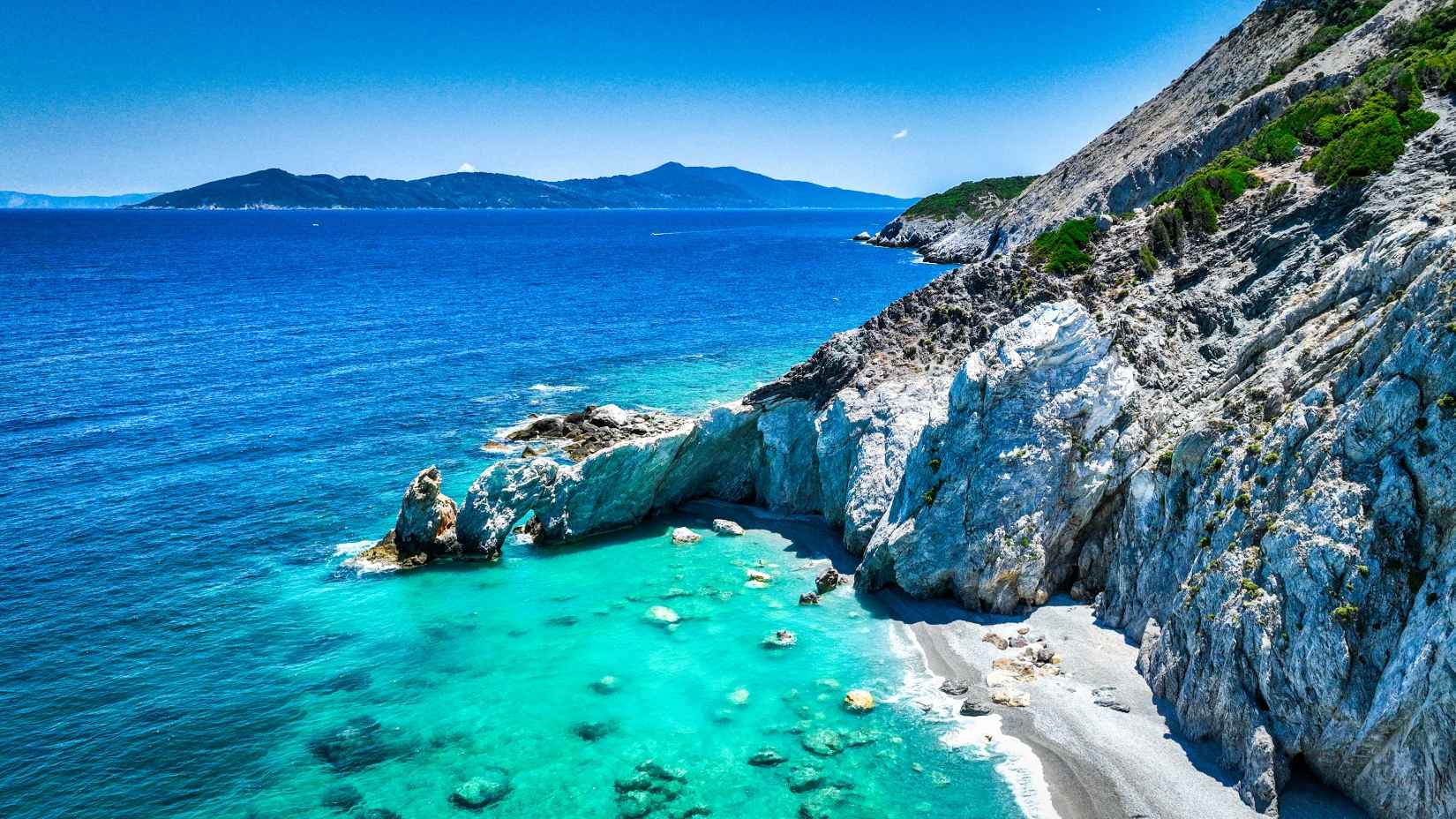
Of all the beaches in Skiathos, Lalaria Beach is probably the one that best represents the island’s wild side. Located along the spectacular northern coast and normally accessible by sea, Lalaria has become one of the iconic places not only of Skiathos but of the entire Sporades archipelago.
The landscape is completely different from the long sandy beaches of the southern coast. Here, large pale rock faces, distinctive white pebbles and a sea that, thanks to the seabed and the light, takes on shades ranging from turquoise to deep blue dominate the scenery.
Arriving at Lalaria by boat also allows you to admire the rugged northern coastline of Skiathos from the sea, characterised by cliffs, caves and rock formations shaped over time by wind and waves.
The symbol of the beach is Tripia Petra, the spectacular natural arch carved into the rock and extending directly into the sea, one of the most photographed sights on the island.
Lalaria, however, is also a particularly delicate natural environment. Its characteristic white pebbles are an integral part of the landscape and must remain on the beach: taking them away as souvenirs contributes to the gradual alteration of one of Skiathos’ most precious places.
For anyone planning a holiday on the island, a boat trip to Lalaria is certainly one of the experiences to include among the things to do in Skiathos, while always remembering that access by sea can depend on weather and wind conditions.
If Lalaria represents the most spectacular face of Skiathos’ natural landscape, Kastro tells an essential part of the island’s history. Located on an imposing rocky formation overlooking the northern coast, the ancient settlement occupied a naturally protected position that was particularly difficult to reach.
The inhabitants of Skiathos moved here during the Middle Ages to seek protection from the frequent pirate raids that affected the Aegean Sea. The shape of the rock and its elevated position made it possible to monitor the surrounding sea and made Kastro far easier to defend than settlements located along the coast.
Walking through Kastro in Skiathos today, you can still see:
But visiting Kastro means above all coming into contact with a Skiathos that is profoundly different from the organised beaches and lively venues of Skiathos Town.
The landscape is dominated by rock, Mediterranean vegetation and the open sea. From above, the view stretches across long sections of the northern coast and, on the clearest days, the panorama over the Aegean Sea becomes one of the most moving aspects of the visit.
Kastro is therefore not only a place to include among the historical sites to see in Skiathos, but a true landscape experience. It is one of those places where history and nature seem to merge and where you can still understand how profoundly the sea influenced the lives of the people of the Sporades over the centuries.
For those who want to discover Skiathos beyond its most famous beaches, Lalaria and Kastro are two almost complementary destinations: the first tells the story of the power of nature, while the second preserves the memory of the island’s history. Together they reveal what is probably the most authentic, spectacular and surprising side of the northern coast of Skiathos.
Skiathos is best known for its beaches and the intense shades of blue of its sea, but you only need to leave the coast and head inland to discover a completely different island. The inland area of Skiathos is surprisingly green, crossed by pine forests, olive groves, small rural areas and trails leading to some of the island’s most authentic and lesser-known places.
Despite its relatively small size, Skiathos has a particularly interesting network of hiking trails. Walking through the interior means crossing pine-scented forests, encountering small churches, monasteries, springs and panoramic viewpoints from which your gaze stretches towards the Aegean Sea.
Hiking in Skiathos is therefore an excellent alternative to spending every day exclusively on the beach and offers a different way to discover the island, especially during spring, early summer and the months of September and October, when temperatures are generally more suitable for walking.
Some routes lead towards more secluded beaches, while others cross inland areas and reach ancient religious sites. It is precisely here that two of the island’s most important spiritual and cultural landmarks can be found: the Monastery of Evangelistria and the Monastery of Panagia Eikonistria.
Among the things to see in Skiathos beyond the beaches, the Monastery of Evangelistria certainly deserves a prominent place. Surrounded by the greenery of the inland hills, it is one of the island’s most important religious, historical and cultural sites and offers the opportunity to discover a part of Skiathos’ history that is often unknown to first-time visitors.
The monastery was built between the end of the 18th and the beginning of the 19th century in a secluded position surrounded by dense vegetation. The peaceful surroundings and distance from the busier coastal areas still create an atmosphere completely different from that of the main tourist resorts.
Its importance, however, is not linked exclusively to religious life. The Monastery of Evangelistria in Skiathos played a significant role during the years leading up to and surrounding the Greek War of Independence.
According to tradition, one of the first flags associated with the birth of modern Greece was blessed inside the monastery. For this reason, Evangelistria holds a special place in the historical memory of the island and is considered one of the symbolic locations of local history.
A visit offers the opportunity to observe the architecture of the monastic complex and experience a more intimate side of Skiathos. The monastery preserves evidence of its religious and cultural history, and visiting it allows you to better understand the deep connection that linked the island’s population to the Orthodox tradition for centuries.
Even the journey to reach it is part of the experience. As you move away from Skiathos Town, the landscape gradually becomes greener and quieter, revealing just how different the island’s interior is from its coastal resorts.
The Monastery of Evangelistria is therefore a particularly recommended stop for those who want to combine sea and culture during a holiday in Skiathos. It can easily be included in a day dedicated to exploring the interior or combined with a walk through the surrounding trails and pine forests.
Another important religious site to discover during a holiday in Skiathos is the Monastery of Panagia Eikonistria, deeply connected to the island’s spiritual traditions and history.
Located inland and surrounded by vegetation, the monastery once again allows visitors to discover a side of Skiathos far removed from its busiest beaches and the liveliness of the town.
The story of Panagia Eikonistria is linked to an ancient religious tradition. According to the story passed down through generations, a sacred icon of the Virgin Mary was found in this area, an event from which the site’s spiritual importance to the island’s inhabitants derives.
Panagia Eikonistria holds a particularly important place in local devotion and demonstrates how deeply religious traditions remain intertwined with the history and cultural identity of Skiathos.
The location of the monastery adds further charm to the visit. The surrounding landscape is characterised by the greenery of the interior, silence and an intimate atmosphere that invites you to slow down and observe a side of the island completely different from the familiar images of its beaches.
Visiting the Monastery of Panagia Eikonistria therefore means not only discovering a religious building, but also coming closer to local traditions and culture, adding an experience to your holiday that is very different from the classic days spent by the sea.
For those who love exploring, the inland area of Skiathos can become one of the most pleasant surprises of the journey. Trails, pine forests, olive groves, small religious buildings and monasteries show that the island has much more to offer beyond its famous beaches.
Devoting at least one day to discovering the greenest and most authentic side of Skiathos allows you to complete your journey by alternating sea, nature, hiking, history and culture. The Monastery of Evangelistria and the Monastery of Panagia Eikonistria are two particularly interesting stops along this route and help you understand an island that, despite its international reputation as a beach destination, still maintains a strong connection with its land and traditions.
Skiathos is ideal for those who love walking.
The trails cross:
Spring and the month of June are particularly suitable for hiking.
Skiathos is an island that invites you to experience it, not simply visit it. Its beaches are certainly one of the main reasons to choose it, but limiting yourself to the sea would mean missing an important part of its charm. Boat trips, monasteries surrounded by greenery, ancient settlements, sunsets over the harbour and evenings in the Chora allow you to create a much more complete holiday.
If you are wondering what to do in Skiathos, these are some of the experiences that are truly worth including in your trip, alternating them freely with days spent on the beach.
One experience not to be missed is seeing Koukounaries Beach just as the day begins. Considered one of the most famous beaches in Skiathos, it attracts numerous visitors during the summer, but in the early hours of the morning it reveals a much more relaxed side.
Arriving early allows you to enjoy the long stretch of sand and the sea while the atmosphere is still peaceful, while also admiring the large pine forest that characterises this part of the island and the nearby natural area of Strofilia.
It is the ideal moment for the first swim of the day, a walk along the shoreline and the chance to appreciate one of Skiathos’ best-known landscapes before the beach becomes livelier.
If there is one image capable of representing the most spectacular side of Skiathos, it is probably Lalaria Beach. Reaching it from the sea allows you to discover a coastline completely different from the southern coast, dominated by rocky cliffs, water in intense shades of blue and large pale pebbles.
The boat journey is part of the experience itself. As you approach the northern coast, the landscape becomes progressively wilder until you arrive in front of the famous beach and Tripia Petra, the characteristic natural arch carved into the rock.
Excursions depend on sea and wind conditions, so it is always advisable to check the situation before departure. When conditions are favourable, Lalaria is without doubt one of the excursions to do in Skiathos.
After a day spent by the sea, one of the most enjoyable moments arrives when the sun begins to set and Skiathos Town changes atmosphere.
The Old Port of Skiathos is perfect for a sunset stroll, when the boats return from their excursions, tavernas begin to come alive and the evening light reflects on the water.
Sitting down for an aperitif, stopping to watch the harbour or simply strolling without a particular destination allows you to fall into the rhythm of the town. It is one of those small rituals that, when repeated during your holiday, often ends up becoming one of the most pleasant memories of the trip.
To discover Skiathos beyond the sea, it is worth dedicating a few hours to its interior and reaching the Monastery of Evangelistria, one of the island’s most important historical and religious sites.
Surrounded by greenery, the monastery offers an interesting contrast to the liveliness of the coastal resorts. Its history is also linked to the Greek War of Independence and to the tradition according to which one of the first flags of modern Greece was blessed here.
The visit can also become an opportunity to explore the roads and trails of the interior, discovering just how green Skiathos becomes as soon as you move away from the coast.
Among the places to see in Skiathos, Kastro is one of those that best tells the story of the island’s past.
The ancient settlement stands in a spectacular position on the northern coast, above a large rocky formation overlooking the Aegean Sea. It was precisely this naturally protected position that made it a refuge for the population during the centuries when pirate raids represented a constant threat.
Today, people come to Kastro to see what remains of the ancient settlement, but also for the landscape. The combination of history, wild coastline and views over the sea makes this visit completely different from a classic day at the beach.
Anyone wishing to discover the most natural side of the island should reserve at least one day for the Mandraki and Elias Beach area.
Here the landscape is dominated by pine forests and the spaces seem wider than on the more popular beaches of the southern coast. The beauty of this day lies precisely in not having too many plans: reach the area, choose where to stop, walk through the vegetation and spend several hours between sea and nature.
It is a particularly suitable experience for those looking for less crowded beaches in Skiathos and who want to alternate the island’s best-known locations with a few wilder corners.
Seeing Skiathos from the sea allows you to better understand its geography and, above all, to reach stretches of coastline that are difficult to access by land.
A boat trip in Skiathos can include swimming stops, secluded bays, caves and some of the best-known places along the northern coast. Routes may vary depending on the type of excursion and sea conditions.
You can choose between organised excursions, smaller boats and private options depending on the type of experience you want. For those who love the sea, dedicating at least one day to sailing is one of the best ways to discover just how different the island’s landscape looks when viewed from the sea towards the land.
A holiday in Greece inevitably includes the pleasure of food. In Skiathos, it is worth enjoying at least one dinner away from the busiest streets and venues, choosing a traditional taverna where you can take your time tasting Greek cuisine.
Rather than necessarily searching for the most famous restaurant, it can be enjoyable to follow your instincts and choose small places also frequented by local residents, order several dishes to share and turn dinner into a true part of the evening.
Greek dishes, local products, fish when available and simple traditional recipes add a gastronomic dimension to your journey, something that is often essential to truly getting to know a destination.
When evening arrives, Skiathos Town, also commonly known as Chora, becomes one of the most enjoyable places on the island.
A walk can begin at Bourtzi, the small green peninsula separating the Old Port from the New Port, before continuing along the waterfront and into the town’s narrow streets.
Here you will find shops, small venues, bars, restaurants and more intimate corners. The beauty lies precisely in alternating the livelier streets with smaller side roads, allowing curiosity to guide you.
It is a simple experience, but an essential one for understanding why Skiathos Town is much more than just a base for your stay: it is the social heart of the island and the place where days that began many hours earlier on the beach often come to an end.
If your stay in Skiathos is long enough, it is worth considering spending a day on nearby Skopelos.
The two islands both belong to the Sporades, but have different personalities. Skiathos is livelier and has a highly developed tourist offering, while Skopelos provides even greener landscapes, spectacular coastlines and an atmosphere that feels more relaxed in many areas.
Skopelos also became internationally famous thanks to the film Mamma Mia!, which was partly filmed on the island, but it would be reductive to visit it only in search of filming locations. Villages, monasteries, beaches and extraordinarily lush vegetation make it a destination that deserves to be discovered for its own identity.
A day trip from Skiathos to Skopelos can therefore add something special to your holiday, especially for those who have several days available and would like a first taste of another Sporades island.
In reality, the best way to discover what to see and what to do in Skiathos is precisely to alternate different experiences. One morning can begin on the sand of Koukounaries and end with a walk around the Old Port; another day can be dedicated to sailing towards Lalaria, while the next can take you through the pine forests of the interior, to the Monastery of Evangelistria or along the traces of ancient Kastro.
It is this variety that makes a holiday in Skiathos so interesting: the sea and beaches remain the main attractions, but around them you can build a journey made up of nature, history, small pleasures, Greek cuisine, excursions and evenings in the Chora. And very often, it is precisely these moments, seemingly secondary compared with the most famous beaches, that become the memories that stay with you the longest.
The Sporades became famous throughout the world thanks to the film Mamma Mia!. Many travellers arrive in Skiathos believing that all the scenes were filmed here. In reality, many of the film’s iconic locations are found on nearby Skopelos.
Skiathos was nevertheless used for some scenes and, above all, is the easiest gateway for reaching the film locations scattered throughout the Sporades. For this reason, a combined Skiathos + Skopelos holiday is particularly interesting for fans of the film.
The cuisine of Skiathos perfectly reflects the identity of the Sporades. Fish, vegetables, olive oil, cheeses and local products take centre stage. The most authentic tavernas preserve a simple style of cooking.
Things to try:
• Fresh fish – especially in tavernas near the harbour and small restaurants by the sea
• Grilled octopus – one of the classics of Greek cuisine
• Calamari – fried or grilled
• Moussaka – aubergines, minced meat and béchamel sauce
• Gemista – tomatoes and peppers stuffed with rice and herbs
• Horiatiki – Greek salad with tomato, cucumber, onion, olives and feta
• Spanakopita – savoury pie with spinach and cheese
• Local cheeses
• Sporades honey
• Loukoumades – fried sweets served with honey
• Tsipouro and ouzo – often accompanied by small mezedes
Eating in Skiathos is above all about sitting down without rushing. Order several dishes, share them and let dinner become part of the evening.
Skiathos has one of the most interesting nightlife scenes in the Sporades. It cannot be compared with the extreme nightlife of Mykonos. The atmosphere is generally more elegant and relaxed. The centre of the island’s nightlife is Skiathos Town.
Here you will find:
The Old Port area is particularly characteristic, where some venues have cushions and seating arranged along the steps. Perfect for enjoying a drink while watching the boats and the activity around the harbour.
Skiathos is particularly suitable for families.
The main advantages are:
The best areas are:
Skiathos can be extremely romantic.
Recommended areas include:
Romantic experiences:
For those who want to combine the sea and entertainment, Skiathos Town is the best base.
During the day, the beaches are easy to reach.
In the evening, you can go out on foot without worrying about transport.
The livelier beaches include:
One of the most beautiful excursions.
Skopelos is larger, more mountainous and even greener.
It is famous for the locations featured in Mamma Mia!.
Perfect for nature lovers. It is connected to the National Marine Park of the Northern Sporades, one of the most important protected marine environments in the Mediterranean.
One of the best experiences for seeing:
The island’s religious and cultural life remains important. During the summer, you will find:
• patron saint festivals
• Greek music evenings
• religious celebrations
• cultural events
• concerts
• theatrical performances
One of the island’s most important celebrations is connected to Panagia Eikonistria, the patron saint of Skiathos. Traditional festivals are a perfect opportunity to discover the less touristy side of the island.
• Best time to visit: from May to September. June and September are ideal for those looking for pleasant temperatures and fewer crowds.
• July and August: the liveliest and busiest months. Book well in advance.
• Climate: Mediterranean, hot and sunny in summer, although the vegetation makes the island greener than many other destinations in the Aegean.
• Meltemi: during certain periods, winds can blow, particularly along the more exposed coasts.
• Money: cards are accepted in most establishments, but it is always useful to carry some cash.
• Language: English is widely spoken in tourist areas.
• Clothing: lightweight clothing in summer. Bring comfortable shoes if you want to explore Kastro and the hiking trails.
• Car: not essential if you only want to visit the southern coast, but highly recommended for exploring the island.
• Boat: at least one excursion by sea is almost essential if you really want to discover Skiathos.
• Sun protection: essential, especially during boat trips.
For a first holiday, we recommend at least 7 days.
In one week, you can:
With 10–14 days, however, we recommend combining Skiathos with Skopelos or Alonissos.
Skiathos is small, but never monotonous. It is green yet deeply Mediterranean. It is lively but not necessarily chaotic. It is tourist-oriented, yet still preserves an authentic soul.
You can choose an organised beach or walk through a pine forest in search of a quieter bay. You can spend the evening in a cocktail bar or enjoy a leisurely dinner in a small taverna. You can have a completely relaxing holiday or transform it into a journey combining sea, hiking, history and other islands.
And it is precisely this versatility that makes it perfect for so many different travellers.
Choosing Skiathos is easy.
Organising Skiathos properly, however, makes a huge difference.
The area where you stay, the distance from the beach, the presence of hills, the type of transport connections, the time of year, the vehicle you rent and the excursions you choose should all be based on who is travelling.
A family with young children should not necessarily stay in the same area as a couple.
A group of friends who want to go out every evening will have different needs from travellers looking for silence and nature.
And someone who wants to combine Skiathos with Skopelos and Alonissos will need a completely different type of organisation.
This is why we can help you build your holiday around your real needs:
We do not simply want to send you to Skiathos, we want to help you find the right Skiathos for you.
Because a holiday becomes truly wonderful when you do not have to adapt yourself to the destination.
The destination is built around the way you like to travel.
Write to us at info@meraviglioseisolegreche.com and tell us how you imagine your holiday in Skiathos.
We can turn it into your next journey through the Sporades.





Pianifica la tua vacanza nelle isole greche
Niente pacchetti standard. Contattaci per un itinerario su misura che cattura l'anima delle isole.
Massimo 2 preventivi gratuiti
Dalle acque cristalline di Mykonos ai tramonti mozzafiato di Oia, il nostro team di esperti locali è pronto a curare ogni dettaglio della tua fuga greca. Non siamo solo un'agenzia — siamo il tuo ponte verso l'Egeo.
Risposta immediata garantita