★★★★★
257 Reviews
Leggi tutte


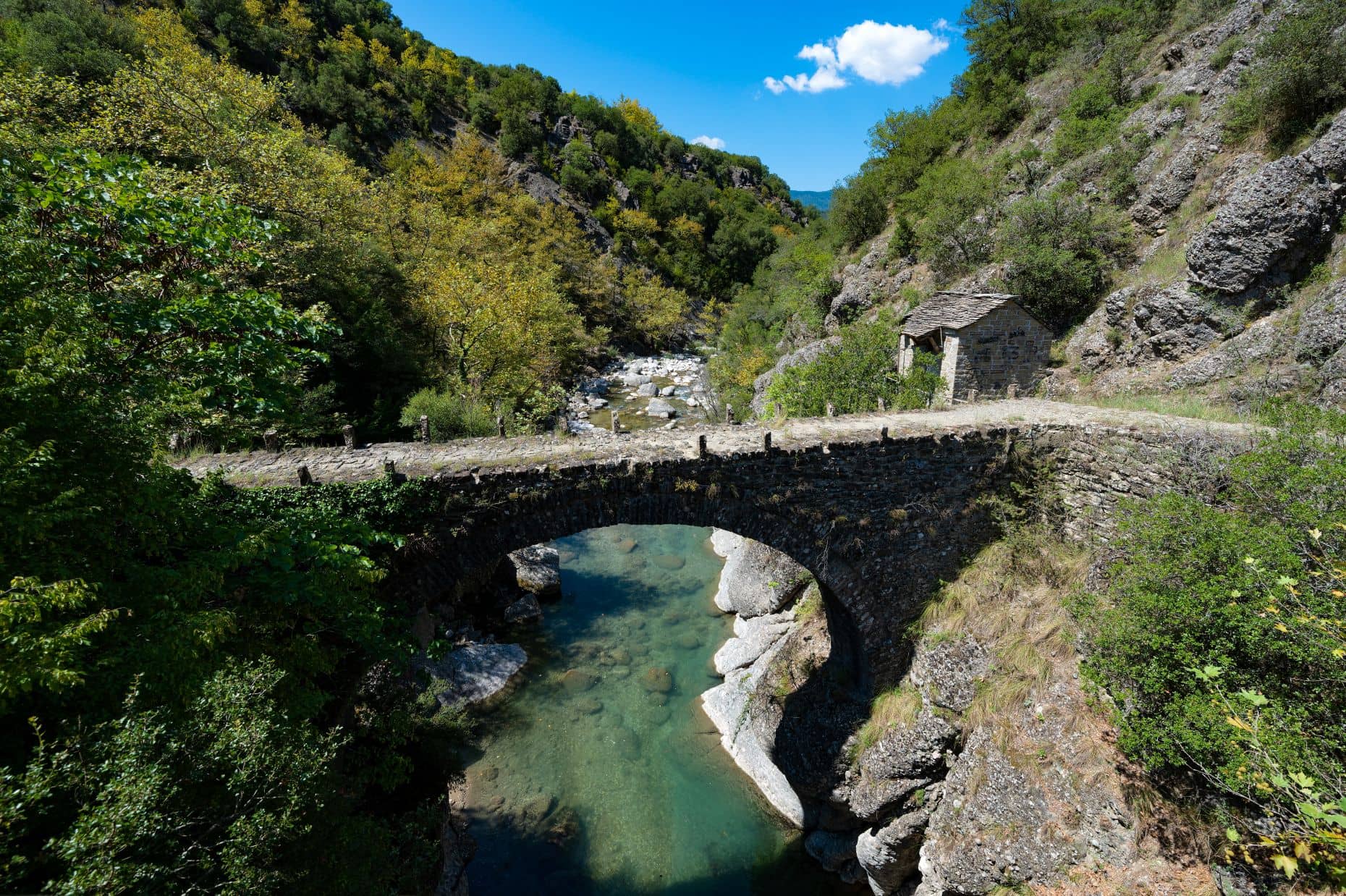
Tzoumerka, Peristeri and Arachthos Gorge National Park is located in north-western Greece, in the region of Epirus, one of the most authentic and unspoilt areas of the country. This mountainous territory, dominated by the peaks of the Athamanika (known as Tzoumerka), extends across the regional units of Arta, Ioannina and Trikala, encompassing an ever-changing mosaic of landscapes: deep gorges, dense forests, stone villages, monasteries suspended above the void, emerald-coloured rivers and wildlife that has become rare elsewhere in Greece.
The park extends around a mountain ridge with peaks rising above 2,400 metres, with steep slopes, deep green plateaus and rock faces that change colour as the hours pass. Dominating everything is Mount Katafygi, one of the most iconic mountains in the range, while the Arachthos River, with its spectacular gorges, literally cuts the area in two, creating one of the most fascinating river environments in Greece.
Geographically, Tzoumerka is a “borderland”: it does not entirely belong to the Alpine landscape, but neither is it Mediterranean. It is a world of its own, a place where nature has expressed itself with a character that is both harsh and generous. Here winters are cold, summers are cool, autumn blazes with a thousand colours, and spring bursts into life with waterfalls and meadows that look as though they have been painted.
Visiting Tzoumerka means entering a world unlike any other area of contemporary Greece: no mass tourism, no artificial resorts, only silence, water, forests and villages that tell centuries of traditions. It is Greece at its most authentic, still living at a slow and ancestral rhythm, where every path brings you closer to nature and every panorama reminds you how precious this corner of Epirus truly is.
Reaching Tzoumerka National Park is an exciting experience in itself: the journey is made up of scenic roads, bends that open onto immense valleys and small villages hidden among towering mountains. And, importantly for those planning an itinerary, despite being a remote place, it is surprisingly well connected.
Main arrival point: Ioannina
The city of Ioannina is the nearest urban centre and the ideal hub for reaching Tzoumerka.
It is easy to reach:
Once you arrive in Ioannina, continue south-east. There are two main entrances to the park:
This is the most famous and scenic area, the gateway to the villages of:
This road offers spectacular views, especially as you approach Mount Strogoula, which suddenly appears like a gigantic pyramid of white rock.
Wilder, less travelled, more poetic. The landscapes are made up of small plateaus, hidden waterfalls and dense forests.
The answer is yes.
Although Tzoumerka is served by a few local buses, the magic of the park lies precisely in the freedom to stop at panoramic viewpoints, reach remote villages, set off on trekking routes and visit monasteries perched high above the landscape that require your own means of transport.
Reaching Tzoumerka is not simply about arriving at a destination: it is about slowly entering a different Greece, more authentic and profound.
The history of the Athamanika is as ancient as the mountains themselves. This region has been inhabited since prehistoric times and, during the Classical period, was part of the kingdom of the Athamani, an Epirote tribe with its own distinctive cultural characteristics, often described by ancient historians as “proud and indomitable”.
The Athamani people played a strategic role in the wars involving Epirus, Macedonia and the Illyrians. Their position, isolated yet dominant over the surrounding territory, allowed them to control the mountain passes and protect trade.
During the Roman period, the area was less urbanised than other parts of Epirus, but it did not lose its importance: it was in fact the natural passage between the inland territories and the Ionian coast. With Byzantium, monasteries took the place of fortifications, transforming Tzoumerka into a place of spirituality and retreat.
The Middle Ages, with the Despotate of Epirus, were a crucial period: mountain communities grew stronger, stone bridges were built that are still considered works of art today, and the inhabitants developed into excellent stonecutters and stonemasons.
During the Ottoman occupation, Tzoumerka became a centre of resistance. The altitude and rugged morphology of the mountains allowed local communities to maintain a high degree of autonomy. Rebels, monks, intellectuals and anyone seeking freedom found refuge here. Many villages played a leading role in the Greek Revolution of 1821.
The 20th century brought difficult periods: wars, migration, depopulation. But this very isolation is what makes the park special today: a territory that has remained authentic, with unspoilt nature and a traditional culture that is still alive.
Tzoumerka is not just nature: it is a living archive of Epirote history, shaped by resistance, spirituality and tenacity.
Epirus is one of the richest regions in mythology in all of Greece, and Tzoumerka is no exception. Here myth is not simply an ancient tale: it is part of the landscape.
The first legendary figure linked to Tzoumerka is Athamas, king of the Athamani, from whom the Athamanika take their name. Athamas is the protagonist of tragic and fascinating stories, including that of his children Phrixus and Helle, saved by the famous ram with the Golden Fleece. Local tradition holds that Athamas ruled over these very mountains.
Another important myth concerns Arachthos, the river that flows through the region. According to legend, the river was formed from the tears of a nymph betrayed by Zeus. Her sorrow gave life to a powerful and impetuous watercourse, which still flows forcefully through deep gorges today as though guarding an ancient secret.
The mountains of Tzoumerka were considered home to nymphs, spirits and minor deities. In particular, many caves were believed to be gateways to the world of the chthonic gods. Local tribes performed propitiatory rites in spring to ensure water, protection and fertility.
Also fascinating is the myth linked to Mount Strogoula, the most iconic mountain in Tzoumerka. Its perfect pyramidal shape led the ancients to consider it a sacred mountain. It is said that on full-moon nights mysterious lights could be seen on its summit, interpreted as ritual fires or divine presences.
During the Classical period, the region was closely linked to the sanctuary of Dodona, the oldest Greek oracle, located a few kilometres from Tzoumerka. It is very likely that pilgrims from the mountain villages travelled along these paths to reach the oracle of Zeus’s sacred oak.
Mythology, in the Tzoumerka region, is an integral part of local identity: tales of mountain witches, nymphs inhabiting waterfalls and benevolent spirits protecting the villages are part of the folklore still recounted by the elderly today.
Tzoumerka is a treasure trove of interesting facts, one of those destinations that surprises you more and more the better you get to know it.
Despite its spectacular beauty, it is still little known to international tourism. This means unspoilt landscapes, authentic villages and absolute tranquillity.
Some of the Ottoman bridges of Epirus – such as the famous Plaka Bridge over the Arachthos River – are true works of traditional engineering. Built without cement, they have survived for centuries thanks to the perfect interlocking of the stones.
For centuries, the craftsmen of Epirus have been among the most renowned in the Mediterranean. Entire “schools of stone” originated in Tzoumerka, masters who built houses, churches and bridges throughout Greece.
The area is one of the places with the highest concentration of waterfalls in the country. The most famous are those of Kefalovryso and Theodoriana, but many others are hidden in remote valleys.
The Arachthos gorges and secondary ravines attract enthusiasts from all over Europe. The water is crystal clear, the walls incredibly high, the experiences unforgettable.
Some villages seem suspended in the past: houses built entirely of stone, small squares, old kafenia, perfectly preserved cobbled streets. In many of them, the resident population does not exceed ten people in winter.
Epirus is famous for its comfort food:
Eating here means tasting traditions that have been lost elsewhere.
Tzoumerka is a place to be experienced slowly, listening to stories, observing details, following the natural rhythm of the mountains.
Tzoumerka National Park is a concentration of natural, cultural and architectural wonders. Here there are many breathtaking experiences that simply cannot be missed.
Built into the face of a cliff and accessible via a small wooden bridge, it is one of the most spectacular monasteries in Greece. It looks like an eagle’s nest, suspended above the void.
A spectacular waterfall that reaches its greatest power in spring. The trail leading to it is easy and immersed in a cool, fragrant forest.
One of the largest arched bridges in the Balkans. Faithfully reconstructed after its collapse in 2015, it is a symbol of Epirote tradition.
Pramanta is the most vibrant village in the area, while Strogoula is the iconic mountain of the park. The view from the summit is one of the most beautiful in the Pindus.
A stone jewel at an altitude of 1,150 metres. Houses, roofs, streets: everything is made from local stone. It looks like an open-air museum.
The twin village of Syrrako, homeland of craftsmen, traditional silversmithing and epic landscapes.
A paradise for rafting and canyoning. The water is transparent, the walls hundreds of metres high. It is one of the most exciting experiences in Epirus.
A poetic, silent place, ideal for those who love walking far away from everything.
Immersed in nature, scented with pine and chestnut trees. A powerful spiritual atmosphere.
Here every step reveals a new panorama. Every bend brings a new emotion.
Tzoumerka is not just a place to visit: it is a feeling that stays in your heart.




Pianifica la tua vacanza nelle isole greche
Niente pacchetti standard. Contattaci per un itinerario su misura che cattura l'anima delle isole.
Massimo 2 preventivi gratuiti
Dalle acque cristalline di Mykonos ai tramonti mozzafiato di Oia, il nostro team di esperti locali è pronto a curare ogni dettaglio della tua fuga greca. Non siamo solo un'agenzia — siamo il tuo ponte verso l'Egeo.
Risposta immediata garantita