★★★★★
257 Reviews
Leggi tutte


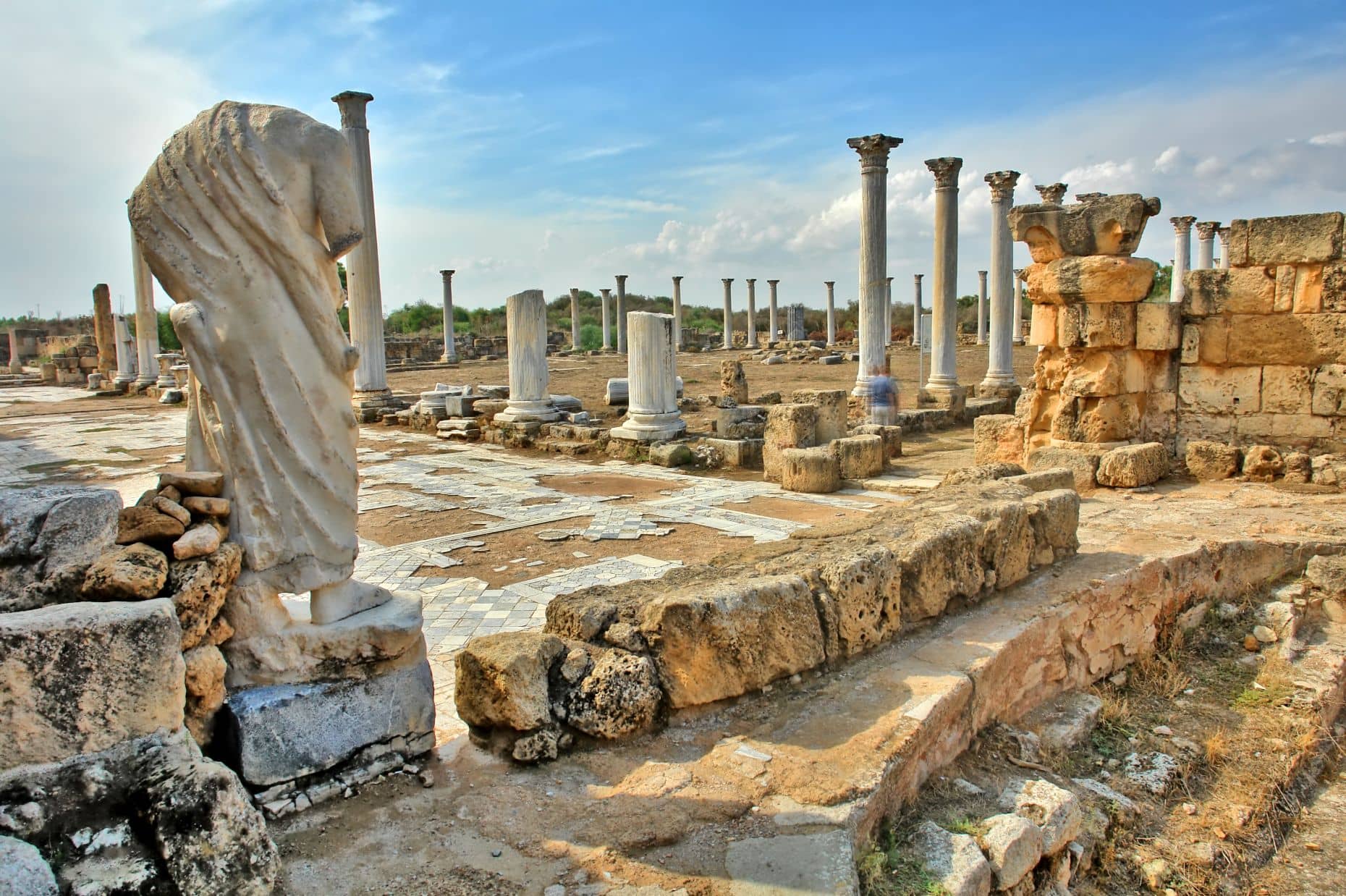
Salamis (or Salamina), one of the most important ancient cities in the eastern Mediterranean, is located along the eastern coast of Cyprus, north of present-day Famagusta. The archaeological area stretches along a surprisingly unspoilt section of coastline, where the sea takes on changing shades between turquoise and emerald and the breeze still carries the echoes of the civilisations that were born, flourished and fell here. It is a place suspended between distant eras, where every column, mosaic and stone tells a fragment of the island’s long history.
Located in a strategic position, Salamis was the maritime gateway to ancient Cyprus, a commercial crossroads connecting the Aegean, the Levant, Egypt and Anatolia. Its sheltered coastline, shallow waters and proximity to the main routes made this place one of the most prosperous urban centres of antiquity. Today the entire area belongs to the northern part of the island, under Turkish Cypriot administration, but remains one of the most fascinating destinations for those who wish to understand the cultural, artistic and political origins of Cyprus.
The archaeological site extends along a wide stretch of coastline, surrounded by golden sand dunes, the scents of wild mint and mastic, with Mediterranean vegetation reminiscent of the unspoilt nature described in ancient poems. Here the landscape is not merely a backdrop: it is an integral part of the experience. The ruins emerge from the earth as though they were only temporarily asleep, ready to reveal ancient secrets to those who walk among their geometries.
Salamis is not simply a place to visit, but a true journey through time: every step takes you back to an era when art was a universal language, trade carried the flavours of Mediterranean spices, and myths had the same power as history. It is a perfect destination for travellers passionate about archaeology, those curious about culture, those who love authentic places and those seeking profound and memorable experiences, far from the most predictable tourist routes.
Reaching Salamis today is a true journey of discovery combining the Mediterranean Sea, history and a touch of adventure. The site is located in the northern part of Cyprus, and for this reason the journey involves a few particular logistical steps, but nothing complicated if planned carefully.
Arrival in Cyprus
The easiest access point is Larnaca International Airport, which is approximately 50–60 minutes from the nearest border crossing. Alternatively, you can fly into Paphos Airport, but the distance is twice as far and the journey longer.
Once you arrive, there are two options:
From Famagusta to Salamis
Once you have crossed the border, continue towards Famagusta. The city is the closest geographical reference point to the site: from here to Salamis the journey is just 6–8 km, which can be covered by taxi, rental car or local bus.
The best means of transport? A car.
It allows you to move freely between the various sections of the site, some of which are located at a distance from one another and surrounded by nature.
Those who prefer not to drive can instead opt for local taxis: prices are affordable and the routes direct.
Access to the archaeological site
The entrance is easy to identify thanks to the large parking area. From there, a well-signposted route begins among basilicas, baths, theatres and necropolises. Remember that the site is enormous: bringing water, a hat and comfortable shoes is essential.
Reaching Salamis is not simply about travelling from point A to point B: it means crossing a physical and cultural border, an experience that in itself introduces you to the ancient complexity of this wonderful island.
The history of Salamis is a fresco spanning more than three thousand years. Founded according to historians in the 12th century BC, the city soon became one of the most influential centres on the entire island. But its origins are rooted in an even deeper context, linked to the Mycenaean diaspora following the collapse of the great palaces of the Aegean.
The prosperity of Salamis was immediate: the city controlled a coastline rich in natural harbours and was located along the most important trade routes of the time. Metals, wine, oil, ceramics, perfumes, textiles: everything passed through here. With the arrival of the Assyrians, the Persians and later the Hellenistic Greeks, the city never lost its central importance. On the contrary, each conquest added a new architectural, administrative and cultural layer.
Under Roman rule, Salamis experienced one of its periods of greatest splendour. The streets were enriched with colonnades, while baths, amphitheatres, gymnasiums and basilicas were built. The city became a point of reference for the whole of Cyprus, both politically and religiously.
But the history of Salamis also witnessed a devastating event: the terrible earthquake of the 4th century AD that razed much of the city to the ground. The inhabitants attempted to rebuild it, but the economic crisis and political difficulties of the time made it almost impossible to restore it to its former splendour. Gradually, the population moved towards new urban areas, leaving Salamis to a slow and silent abandonment.
Today the ruins tell an incredibly rich story. The great broken columns, the mosaics hidden beneath layers of sand, the remains of the ancient Roman baths: everything speaks of a city that has never truly ceased to live. And walking among these ruins means immersing yourself in a narrative that spans the centuries, from the Mycenaean age to early Christianity.
Salamis is an open-air archive: a place where the ancient Mediterranean still breathes.
Salamis is not simply a historical place: it is a mythological epicentre. Its foundation, according to legend, is linked to Teucer, son of Telamon and half-brother of Ajax. After the Trojan War, Teucer was unable to return to his native island, Salamis in Greece, because he was accused of failing to save Ajax during the conflict. So he set sail with a group of loyal men and landed on the shores of Cyprus. Here he founded a new city, giving it the same name as his lost homeland.
This epic narrative is not simply a myth: it became so deeply rooted in local identity that for centuries the kings of Salamis claimed to be direct descendants of Teucer, thus legitimising their power with a heroic aura.
The mythology of Salamis is also rich in other fascinating elements. It is said that the city was one of the favourite destinations of the goddess Athena, particularly revered by the ancient Cypriots. One legend tells that the goddess appeared to the young Teucer at the moment when he chose the place where the new city would be founded, pointing with her spear to the exact spot where the harbour and the first urban settlement arose.
Another myth concerns Aphrodite. According to some local traditions, the goddess of love – born from the waters of Cyprus at Paphos – also frequented the coast of Salamis, where the sea takes on shades reminiscent of her divine origins. There is no shortage of folk tales about sailors who swore they had seen female figures emerging from the waves on full-moon nights.
Also very evocative is the presence of mystery cults linked to Dionysus. Inscriptions and remains have been found at Salamis that suggest the existence of Bacchic ceremonies celebrated in the ancient theatre, with rituals combining music, wine and ritual dances.
The mythology of Salamis, therefore, is not simply a poetic embellishment: it is a common thread connecting the peoples who inhabited this city. Every story, every legend, every echo of the past makes this place even more fascinating, capable of transporting the traveller into a world where history and myth merge without boundaries.
Salamis is a place full of surprises, and many of its interesting facts do not appear in traditional guidebooks but circulate among archaeologists, enthusiasts and attentive travellers.
One interesting fact concerns its original size: the city was enormously larger than what can be seen today. Many parts are still buried beneath the sand or submerged by the sea. Archaeologists estimate that only 20–25% of the city has been brought to light.
Another interesting fact concerns the ancient theatre. Today only part of the structure can be seen, but originally it could accommodate more than 15,000 spectators, making it one of the largest in the entire eastern Aegean.
Also interesting is the water supply network: the Romans equipped Salamis with an extraordinarily complex system of pipes, which distributed water from nearby springs to the baths, public fountains and wealthier homes. Many sections are still visible and demonstrate a truly advanced level of engineering.
Fascinating is the tradition according to which Paul and Barnabas, during their evangelical mission, visited Salamis in the 1st century AD. Barnabas, a native of Cyprus, began the spread of Christianity on the island here.
Then there is a little-known but magical detail:
In the early hours of the morning, before visitors arrive, the archaeological area fills with migratory birds arriving from Africa and Asia. The coast of Salamis is in fact an important stop along their migration routes. It is a natural spectacle of rare beauty that adds poetry to an already extraordinary place.
Finally, many people do not know that the entire area was once an enormous source of sand for modern construction in the region. Fortunately, in the 1970s the excavations were stopped to permanently protect the ruins. Otherwise, today we might no longer have the privilege of walking among these wonders.
The archaeological site is immense, and to truly enjoy it you need at least 2–3 hours. Here are the unmissable stops:
A monumental complex with pools, hot, warm and cold rooms, mosaic floors and an underground heating system. It is one of the best-preserved thermal complexes in the entire eastern Mediterranean.
An enormous colonnaded courtyard where young men trained and studied philosophy. Walking here means imagining the voices, footsteps, lessons and athletic competitions that took place every day.
A place that stirs the emotions. Although only partially restored, it allows you to understand the enormous cultural importance that Salamis held during the Hellenistic and Roman periods.
Including the Basilica of Campanopetra, a masterpiece of early Christian architecture. Its fallen columns, the sea in the background and the mosaics emerging from the sand create an almost mystical atmosphere.
Remains of Mycenaean, Geometric and Archaic tombs with exceptional artefacts (now preserved in the museums of Cyprus). It is one of the oldest areas of the entire site.
It seems incredible, but part of the city is now below sea level. When the sea is calm, in some places it is possible to see submerged remains even with the naked eye.
Small but essential for understanding the daily life of the inhabitants: tools, statues, coins, ceramics, jewellery.
Every corner of Salamis tells of a different world: political, religious, artistic, maritime. It is not a site you simply visit: you experience it.





Pianifica la tua vacanza nelle isole greche
Niente pacchetti standard. Contattaci per un itinerario su misura che cattura l'anima delle isole.
Massimo 2 preventivi gratuiti
Dalle acque cristalline di Mykonos ai tramonti mozzafiato di Oia, il nostro team di esperti locali è pronto a curare ogni dettaglio della tua fuga greca. Non siamo solo un'agenzia — siamo il tuo ponte verso l'Egeo.
Risposta immediata garantita